Enemy Constellations: What they are, Why you should care, How to beat them
GHub Platform · Гайд · 0 ответов · 17 просмотров
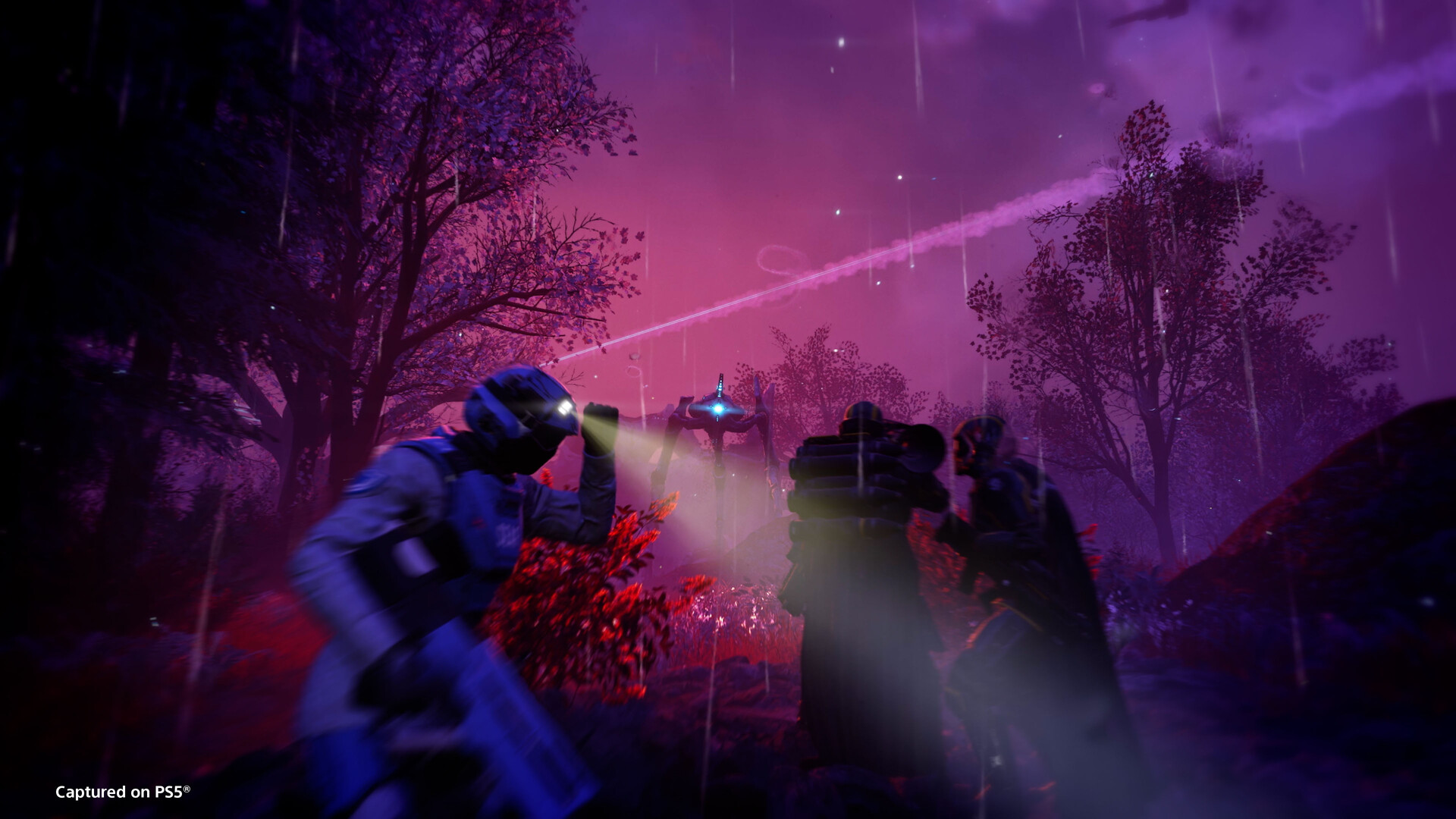
Basically, it's why some missions look like this: And some missions look like this: This guide will break down the mechanic behind this phenomenon, including how to know what constellations you might encounter in a mission, and descriptions of all currently known constellations. What is a Constellation? A "Constellation" is a hidden property on each mission that determines which enemy types are able to spawn, and how often . For instance, you've probably noticed that Bile Spewers only spawn on certain missions, and never seem to show up on others - this is determined by the active constellation. However, constellations don't just affect these "unique" spawns, but also the distribution of "typical" enemies - for instance, a Bug constellation may spawn more Hunters, but fewer Chargers . While constellations seem entirely random at first, they are actually chosen randomly from a limited pool, based on the combination of Mission Type, Campaign Type (Liberation or Defense), and Operation Type (City or Non-City) . In other words, if the Mission Type, Campaign Type, and Operation Type are the same between two mission nodes, the pool of spawnable constellations is the same - if any of those 3 factors change, the pool will most likely be different. 40-minute mission types all have a pool of 2 or less , with some having only one (notably Launch ICBM on Liberation campaigns), and sub-40-minute mission types can choose from all possible constellations . Which missions spawn what constellations? Each faction currently has some fixed number of constellations - I believe this number is 5 for each faction, though testing is still ongoing to identify all of them . Previously these could be categorized quite neatly, but in the current patch, you basically just need to memorize a bunch of tables to know which constellations can show up for a given mission (these can be found in a later section). I don't know why the system works like this, or whether it's even intended, but that's how it works. On a technical level, it may be easier to think of this as the game distributing the constellations across all mission types that are "in rotation" for an operation. In other words, if an operation has 3 mission types to choose from (excluding Blitz/Exterminate/etc), the constellation pools will be spread across those mission types such that all constellations can be encountered, and spawn similarly frequently. If a 4th mission type were added to the rotation, the pools would be reassigned to maintain that even spread. What does it affect? Constellations affect the composition of: Patrols Reinforcements (dropships and breaches) Static spawns (points of interest, outposts, main/side objectives, etc.) Urban patrols (these are different from regular patrols) Exterminate mission spawns (these are different from reinforcements) Summoner unit spawns (such as Bot Fabricators, Bug Holes, and Brood Commanders) Note that each of these categories has different weights for enemy spawns, meaning you may see an enemy more often in patrols than in breaches. This varies from constellation to constellation, and is particularly relevant for Exterminate missions, which often play differently from regular missions on the same constellation. Note also that static spawns have unit type restrictions - usually these just ensure that large units don't spawn where they won't fit, but some structures also have guaranteed Hulk, Tank, or Charger spawns. The same is true of summoner unit spawns. If it's random, how do I play around it? If you know only 1 or 2 constellations are possible based on the mission type, you can obviously tailor your loadout to suit those constellations. Otherwise though, just generally pick a loadout that isn't "hard countered" by any constellations that might be chosen . Additionally, even if you don't know what constellation you'll be up against, you can react to the active constellation during a mission by trading out support or primary weapons with your team (or, if you're lucky, picking up support weapons from POIs). Support weapon cooldowns are 8 minutes without upgrades, so you can expect to have at least one extra call-in ready before the end of a longer mission. Extraction is where the fight gets most intense, so this can be more relevant than you might think. If your team brought 2 Quasars, a Machine Gun, and a Flamethrower, that could end as a Quasar, 2 Machine Guns and a Flamethrower, 2 Machine Guns and 2 Flamethrowers, or 4 Quasars. Obviously this takes some communication, so it's not always an option. Why is it called a Constellation? In Patch 1.000.200, the following was listed in the patch notes: "Automaton enemy constellations that preferred to spawn more of certain Devastators types did not work and are now functioning as they should. This means that sometimes when playing against the Automatons you will face more Devastators instead of other enemy types." Before this, I had referred to them as "tribes" or "species" (specifically for bugs), but this gave (what seems like) an official name for this mechanic. It's a bit vague, but I think this is the name used by the developers for the mechanic. You might also hear this mechanic referred to as a "spawn seed" or "spawn set". I'll be sticking to "Constellation" throughout this guide for the sake of clarity, but all three terms are equivalent. As for why the developers chose the name "Constellation"? I imagine it has to do with the deeper technical details of the system, as spawn weights influence each other (Brood Commanders almost always spawn with Warriors or Hive Guards, for instance). Each possible spawn can be visualized as a star, and its chance of co-occurring with another spawn (including itself) would be a line, with shorter distances being more likely to co-occur. Taken together, a set of interrelated weights would form a constellation. By picking a star and randomly tracing a path of a certain length (representing difficulty), unique groups of enemies can be generated. With proper tuning, this would naturally create far more interesting engagements than individual random weights. In the sections below, I'll go over every distinct constellation I've been able to identify. These are not based on hard data as it would be very difficult to collect and analyze - this is just from observing the general enemy spawn distributions over a large number of missions, and trying to identify if it matches up with a known constellation, or if it is significantly different. Since some of them only have differences in the spawn weighting of enemies, it's possible that some have been missed or misidentified. These will each have dedicated sections later on with screenshots showcasing what they look like. Since I don't have exact numbers, I've simplified the enemy distributions into a handful of categories, explained below: Unique Spawns : Most enemies will spawn occasionally on all constellations - these are enemies that spawn exclusively on the particular constellations for which they're listed. Spawns Way More : The enemies listed here will spawn far more often when this constellation is active, relative to other constellations. Spawns More : The enemies listed here will spawn more often when this constellation is active. Spawns Less : The enemies listed here will spawn less often when this constellation is active. Note that these are generalized across all spawn types (patrols, reinforcements, static spawns). The exact distribution of enemies in each of these spawn types actually varies by constellation: for instance, on the Bile Bugs constellation, Bile Titans spawn most often as patrols, but on the Jumping Bugs constellation, Bile Titans usually show up in breaches. Most of the notable differences like these are covered in each constellation's dedicated section. After recent testing, apparently ther
ИсточникGHub Platform · автор23.08.2026, 06:23:28
Basically, it's why some missions look like this: And some missions look like this: This guide will break down the mechanic behind this phenomenon, including how to know what constellations you might encounter in a mission, and descriptions of all currently known constellations.…
Войдите, чтобы писать в группе