Optimal Mob Spawning & Farming - Comprehensive Guide!
GHub Platform · Гайд · 0 ответов · 7 просмотров
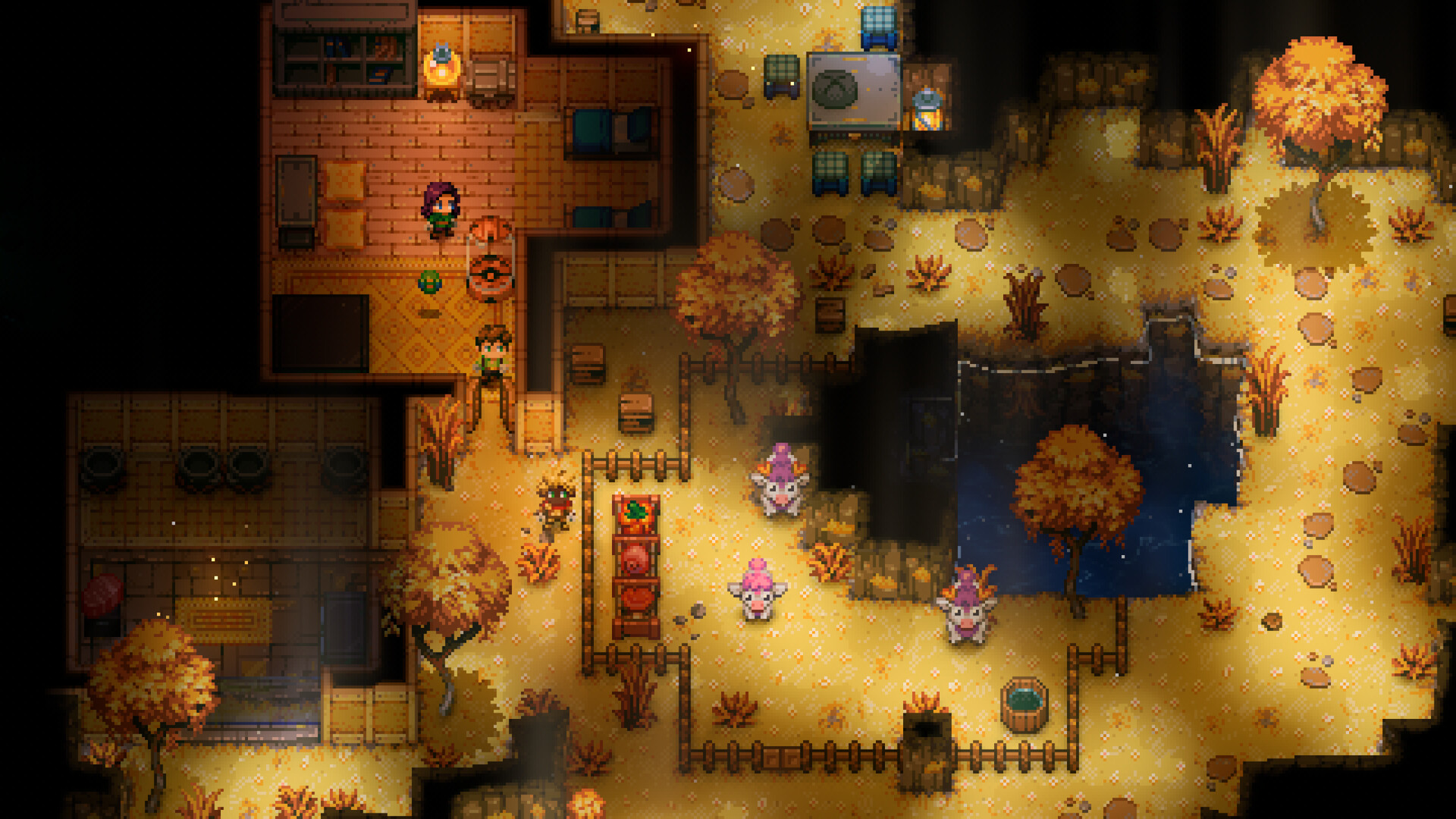
Don't be intimidated by the large amount of written details, here. Just looking at the first couple of infographics will probably give most players a strong idea of the shape of things. Which should make a big difference to how you approach mob farming. The rest is for referencing specific eventualities. Of which I'm kind of trying to cover everything! 😵 Gif (right) of most mob types (in 0.5.1.2) spawning together simultaneously and fighting it out. The simplest type of optimised farm type. Similar to those shown in the first graphic, below, and then explained in Example 1, near the end. Don't be afraid to skip about with the section navigation links, or to ask me a quick question in the comments. I won't tell anybody off for not reading everything! • 1.2 - Update of Spawn Surface Types and Mob/Boss Alliances sheet by Darkon the Mad. See his mob farming guides on YouTube . Old update notes moved to end of guide. This is how the main mob spawning algorithm currently works in Core Keeper 0.5.2.1 (graphic made in 0.4.3). It was discovered after weeks of careful in-game experiments (and one major dead-end). Understanding these basics will let you design drastically more productive farms. Fully illuminated world map by Craigins. "Mob Grid" lines can be shown by the Map Tool [maptool.ceschmitt.de] for your map, updated in real time as you play (follow instruction there). ► Annotations in more detail: (a) The world is divided up into 16 x 16 tile cells (of 256 tiles area), by the mob spawning algorithm. (b) Only cells that have their centres within 208 tiles of the player's current position can receive spawn events. (c) This is a roughly 13 cell radius. So ~530 cells can be active at the absolute maximum. (d) The transition between cells is between tiles. And the origin of the world coordinate system is the bottom left corner of the default spawn location tile. From there you could manually measure out cell boundaries, without using the Map Tool website. (e) Spawn events occur at a different time for every cell. (f) Spawn events have a 15 minute interval by default, for cells in a new world, or a very isolated part of an old map. But this can rise to as high as 22 minutes. Which seems to be (from my limited testing) when more of the (64x64 tile) map chunks have been generated, by exploration, within the 200 tile radius around the player's current position. (g) A spawn event looks at all the tiles in a cell, starting from the bottom left. Scanning right, then up to the next row. (h) For each tile of valid spawn surface that it finds, it rolls the appropriate set of chances for the related mobs (see below). (i) Every mob is treated separately. So that, many (or theoretically * all *) different types can be spawned simultaneously. Not reducing the chances at all for mobs from different surface types. (j) Optimal farm design will try to maximise the number of different mobs spawned in every cell, within range of player. (k) Biome borders are geometrically defined, ignoring the undulating canyons and contrasting ground type. The biome your character is currently stood in is always shown at top right of the full map. No name is shown (blank) for dirt/neutral biome, between the others. This is relevant for some spawn surfaces (explained below). (l) The angle of the biomes is randomly assigned at world creation, so everyone's map looks different. Below - mobs are in rows according to the spawn surface type(s) they can come from. These are grouped and colour coded by which other mob types and bosses they are unable to hurt. I've called these 'alliances'. And yes, mobs can be used to farm bosses! 2026-02-25 - Update for Core Keeper 1.2 : Dakon has kindly provided an new table graphic (see his mob farming tutorial YouTube series , also in "Links" section below): My original from CK 0.5.1.2: ► Explanation of column headers, etc: • " Max Spawns per Event " - Most mobs are limited to have only 1 of that exact type spawned in any given event. Regardless of how many tiles of their spawn surface are present. Mold infected Cavelings are an exception with 4. Mushrooms with 2 (though not strictly a mob). • " Min Tiles Req(uired) " - no mobs are permitted to spawn unless the algorithm finds at least this number of their spawn surface tiles in the current cell. Most commonly, this is 6 tiles. Note: strictly speaking, the 1 limit is actually 0. But, logically, nothing can spawn without at least 1 tile, anyway. • " Spawn Chance per Tile " - these percentage odds are rolled for every mob type that can spawn, for each surface tile the algorithm finds in a cell, during a spawn event. Source : the above 3 quantities, for each mob, were 'data mined' directly from game asset files. With the help of guide instructions from Cysidus, who uses this technique to to gather precise information for the Wiki [corekeeper.atma.gg] . • " # Tiles for 90% Spawn Chance " - Because there are only 256 tiles in each cell, lower spawn chance mobs may need multiple cells full of their spawn to reach 90% chance. Across multiple, staggered spawn events, of course. 90% is an arbitrary guideline figure to aim for, that's 'good enough'. This was calculated from by figuring out the cumulative chance of *not* getting a spawn in X tiles. See full graph later on for finding all intermediate values! • Spawn chance decay - A pre-existing mob in the cell decreases spawn chance, for that mob type only, by a factor of 5 each. E.g. 30% down to 6%, for one, or 1.2% with 2 mobs. † Not for Mold mobs: Infected are hard capped at 20, Tentacles at 5. As found by careful experimentation (method may be explained at a later date) and appears to correlate numerically with data from asset files, although the exact mathematical route of calculation is not certain. Only the (visibly) topmost spawn surface type has any chance to spawn mobs. Those beneath are blocked. Butt the game is currently quite inconsistent about which other types of tiles will block spawns. In general, those appearing on top of a spawn surface will block it. But there are several types, highlighted in red, that also block slime surfaces that appear on top. This can be useful, though. E.g. to have the poison effect with the risk of spawning purple slimes that might break things. The debuffs, from the various slimes types, all work on mobs (and players) from under Spike Traps. but mostly not through Conveyors. Despite spawning mobs through, without impediment (thankfully). The current exception is acid, with will hurt mobs (not players) through conveyors. Although this is never enough to kill any mobs, on its own. I've shown fences because players can walk along the top or bottom of a tile with a horizontal fence segment on it. If that has a slime type on it too, it appears the player is walking on the slime, but receives no rebuff from it. However, I see no practical use for this. The player character blocks all spawns within a 6 tile radius. So don't stand in the middle of your spawn area: Here's a complete overview of the different base probabilities for spawning each mob type, for every possible number of spawn surface tiles within a single cell: ► Notes: • Small (Sea) Tentacles are listed twice, for their higher spawn chance in coastal tiles vs open water. • 256 tiles is the maximum in each 16x16 cell. • The curves are bunched up near the origin because many types have such a high spawn chance per tile. (Maths heads can look at a version with logarithmic scale, below, to get a clearer view of this region of the graph.) Showing there's no point having more than a dozen tiles for spawning the basic slimes, cavelings, etc. • The diamond points are plotted to show the minimum tile limits. Many mob types already have a very high spawn chance with just this minimum permitted number of tiles. Hence the possibility for very compact farms of these base type mobs. • See there's absolutely no benefit in
ИсточникGHub Platform · автор25.08.2026, 21:00:02
Don't be intimidated by the large amount of written details, here. Just looking at the first couple of infographics will probably give most players a strong idea of the shape of things. Which should make a big difference to how you approach mob farming. The rest is for referencin…
Войдите, чтобы писать в группе