Trees: All That Can Be Told
GHub Platform · Гайд · 0 ответов · 19 просмотров
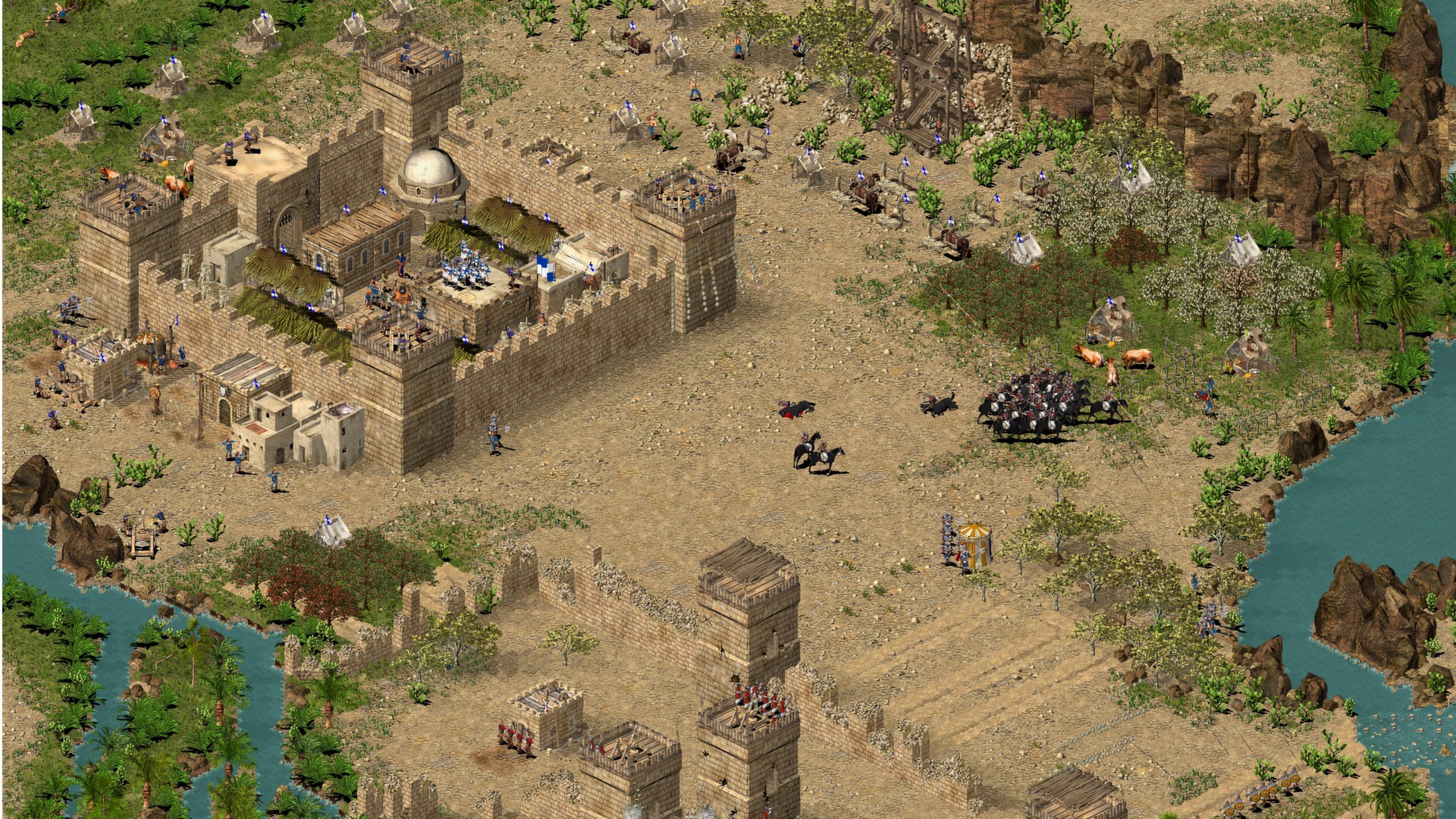
One might think that a guide about trees is not needed. After all, what more could be said than trees provide wood? I beg to differ. There is much more to know about the trees in Stronghold Crusader HD. In this guide, we are going to branch (ha!) into several interesting topics about trees: What kind they are Where they grow How fast they grow How fast they spread How they form stands How they can be stopped How they might die How much wood they yield What this all means We'll even discuss desert shrubs. The game designers in charge of coding the trees of Stronghold Crusader HD (SCHD) kept it simple. Or did they? OK, you already know this, but it still needs to be said: Stronghold Crusader HD has two types of trees: palm and olive trees . And, there are four kinds of trees: Date Palm - probably the most common palm of the area Coconut Palm - Watch your head! Cherry Palm - Another kind of date palm Olive Tree - So, where are the vats of olive oil? There were many other types of trees in the Middle East during the Middle Ages. There were cedars, junipers, figs, mulberries, thorn trees (acacia), pines and oaks to say nothing about numerous fruit trees. In SCHD, we have two types and four kinds of trees, which are plenty. Here’s where the game designers had fun. They allowed the three palms to only grow on the green farmland grasses and the olive tree to grow almost everywhere else. Here is how the four trees compare: There are places a tree cannot grow. No trees grow on: rocks water marsh oil pits stone block a ruin desert shrub And once a farm is built, a tree will not spring up in the middle of it. That's the fancy word for saying trees reproduce themselves. 🌴= 🌴🌴🌴 In the real world, trees regenerate by producing seeds and then letting the seeds disperse all around them. Some of the seeds germinate into sprouts, regenerating the tree. The game simulates this. It lets the palms and olive trees regenerate. They spread across the map, steadily and silently, almost eagerly in Stronghold Crusader HD. Stages of Regeneration Every regenerated tree in SCHD begins as a sprout and grows through four stages to maturity: sprout - a tiny sprig sapling - a larger sprig pole - a shorter version of a mature tree mature - a full grown tree capable of producing seed and sprouts This is how the coconut palm looks in all four stages: The time it takes to grow from a sprout to a mature tree varies by the kind of tree (and varies slightly for each tree of the same kind): ....> About 3 Years: Cherry Palm ....> About 3 1/2 Years: Olive Tree and Coconut Palm ....> About 4 Years: Date Palm (Coconut palm can vary from 3 years to 4 years.) Rate of Spread Do the four kinds of trees in SCHD regenerate at the same rate (same rate of spread)? No. And this is important. The fastest spreading tree is the pudgy cherry palm . It out paces all the other trees. There is not a close second. The cherry palm takes first place on both thick scrub grass and oasis grass. (It does best on thick scrub.) Recall that the cherry palm also matures faster than all other kinds of trees. A single cherry palm will regenerate into over 55 new trees in 15 years. If left to its own devices, cherry palm would become the Greatest Lord on a map of green farm grasses. In second place is the tall, spindly coconut palm on both oasis grass and thick scrub grass. It spreads out at about the same rate on both grasses (about 35 new trees in 15 years from a single start). Sharing second place, sort of, is the date palm on oasis grass. The date palm spreads slightly slower than the coconut palm, but close enough to share second place. Third place goes to the olive tree, on earth, beach and drifting sand landscapes. A single olive tree will regenerate into about 30 new trees in 15 years. Wait, there is a tie. The date palm growing on thick scrub does just as well. Fourth place goes to the olive tree, again, on both scrub grass and earth & stone this time, regenerating about 20-25 new trees over 15 years from a single tree. Let me summarize this another way: On oasis grass, the cherry palm spreads faster than any other palm (recall that olive trees do not grow on farm grasses). And, the coconut and date palms do their best regeneration on oasis grass. The coconut palm does a little better than date palm. On thick scrub grass, the cherry palm explodes in growth, spreading faster than on oasis grass. The coconut and date palms spread well on thick scrub, but not as well as being on oasis grass (in this they differ from the cherry palm). The olive tree spreads faster on barren land with few rocks (driven sand, beach, earth) than it does on lands with rocks and stones (scrub grass and earth & stone). About That Wind The wind in the trees adds motion to the map, nothing else. It does not help spread seeds for regeneration. The game designers cleverly varied the speed of the wind. A constant movement of the trees would have become annoying. The wind cycles through three phases which occur in this order: gentle breezes which rustle the tree leaves, a gust which blows hard against the trees and no wind at all (trees are still). Each cycle lasts about 3 1/2 months. In each cycle, gentle breezes occur for about 2 1/2 months (most of the time) and the gusts and no wind last about 1/2 a month each. I could not detect that the wind played any role in tree regeneration or natural tree death. It only gave some rhythmic sway to the trees. Q: Is there a way to speed up or slow down regeneration through game events? A: No, although there is a tree fungus event which kills trees and by doing so reduces the density of trees. It does not change how fast the trees will spread. Q: Is there a game event which makes trees suddenly appear on a map? A: That would be a nice option, but there is no such event. Q: Do apple trees ever go rogue and spread beyond the orchard? A: No. I have never seen this. This section describes the game mechanics of regeneration. It falls under the category of “Probably More Than You Wanted to Know”, so feel free to skip down to the section on Barriers. Otherwise, prepare to have your mind blown. This has already been stated, but merits repeating as a preface to this section: only a mature tree can produce sprouts. Let’s call this a parent tree. Tree sprouts do not appear willy nilly. The game code of SCHD does not pop up a sprout just anywhere under a parent tree. They appear in a grid pattern around a parent tree. Eight Spots There are only eight spots around a parent tree in which the game code allows a new sprout to appear. This is true for all four kinds of trees. What does this diagram show? Each little square represents a space on a game map as measured by a single column of block. One column of block = one space on a map = one square in the diagram. The grey squares with the little palms are the eight spots where a sprout may appear in relation to the parent tree. Notice that the game code restricts sprouts to exactly four spaces along each cardinal axis and exactly six spaces along each diagonal axis from the parent tree. No closer, no further than what the code is set at. This is why a barrier of six spaces or more stops the spread of trees. A mature tree cannot cast its seed beyond six spaces (a sprout appears in the sixth space). Here is a map view of the 8-spot grid pattern around a cherry palm parent tree. Each spot is marked by a square of earth. In my numerous tests to force a tree to regenerate in a different pattern or with different spacing, none succeeded. The game code is strict: only eight spots at fixed spacing around each parent tree. Randomness At various time intervals, the game code randomly selects which of the eight spots will produce a sprout. At least one sprout will appear each year for each parent tree until the eight spots are occupied. This is not exact, but close. Sometimes two sprouts will appear in a year, and sometimes none from a parent tree. The stubby
ИсточникGHub Platform · автор26.08.2026, 00:44:34
One might think that a guide about trees is not needed. After all, what more could be said than trees provide wood? I beg to differ. There is much more to know about the trees in Stronghold Crusader HD. In this guide, we are going to branch (ha!) into several interesting topics a…
Войдите, чтобы писать в группе