ULTIMATE Guide to Victoria 3 - COMPLETE Tutorial With Video
GHub Platform · Гайд · 0 ответов · 17 просмотров
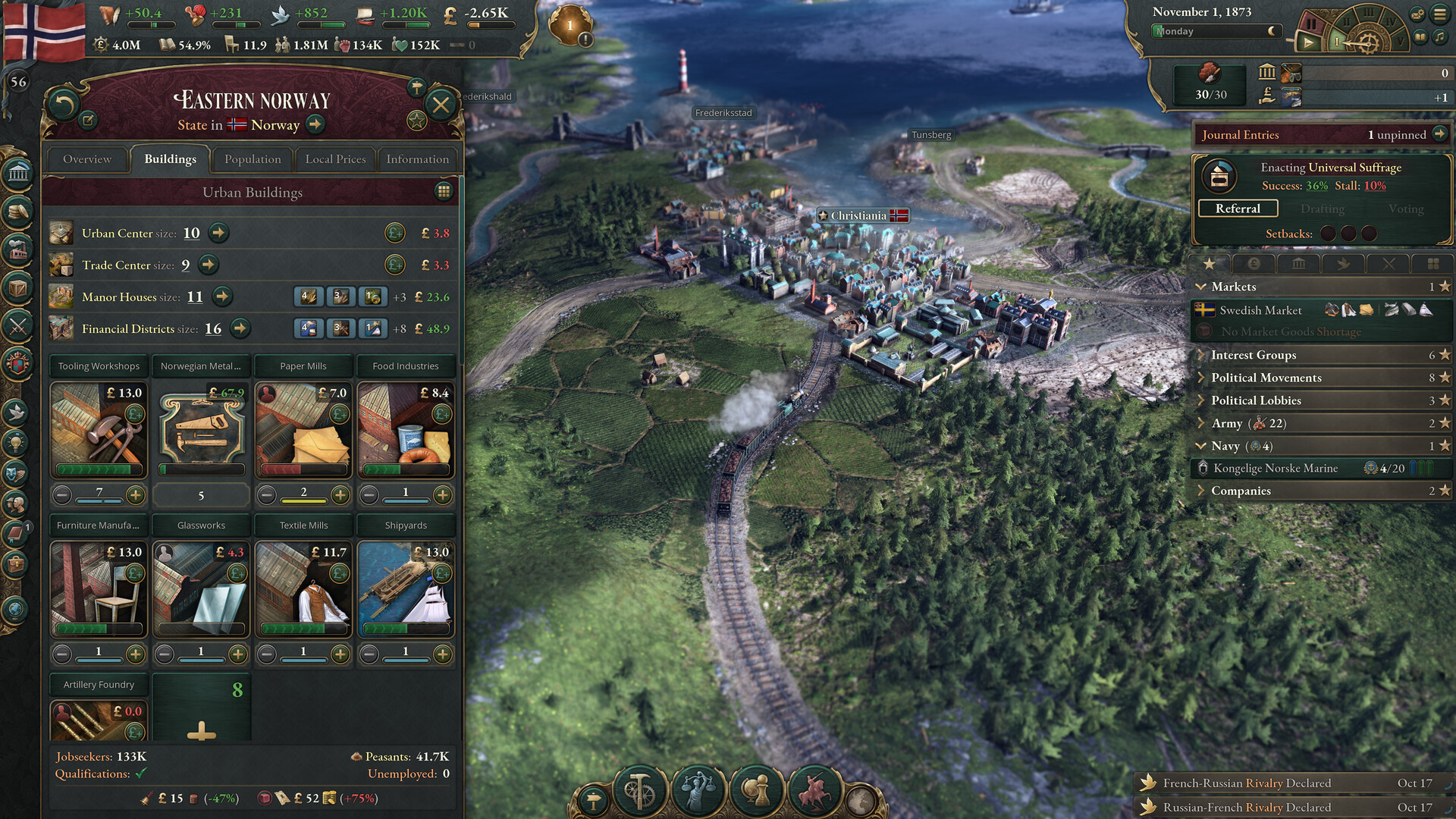
Victoria 3 is a grand strategy game that takes place in the 19th century, and not just in Europe, but the entire world. This means that you can play over 100 different nations all over, whether in good’ol Europe, the Americas, Asia, Oceania, or indeed, Africa. As a first, Victoria 3 even allows you to play the game with certain victory conditions in mind if you wish, declaring a final winner based on one’s economic power, hegemony of the world by force, or how egalitarian one’s society is. You can even play a game where tutorials pop up every now and then to help you on your way, or play the classic sandbox game we all know and love. Before beginning a game, it’s also possible to change the rules of the game, meaning how aggressive the AI is towards the player and others, the nature of formable and releasable nations, and even how subjects appear depending on their overlord. Most notably, as a first, Victoria 3 allows us to play without ironman mode or with a game state that differs from the normal, unmodded game, and still collect achievements. This is a fantastic change because it also means that we can play the game with mods if we so wish, without sacrificing the ability to unlock achievements for our accomplishments. I myself have modded the Ottoman Empire to look red instead of green, which I personally think is a better fit. Every country has it’s own color on the map. Normally, one name goes with one color, say Blue with France, as opposed to yellow for Spain. But in the case of Sweden, its color also shades in Norway. The same goes for Russia and Finland, or Great Britain and India. This means that Norway, in the case of Sweden, is a subject, as in a junior partner or a puppet. If you don’t like the sharing of color between overlord and vassal, you can toggle this feature before beginning your campaign. Every country has their own color as long as they are independent though, and for most of these, the color fills in each country. However, certain countries, like some in South America, Oceania, and most of all in Africa, have no filled-in color. This leads us to the very first game mechanic you should be aware of, namely the ranking of state power, which influences not only your strength on the world stage, but also your very ability to play them. In Victoria 3, we have Great Powers, Major Powers, Minor Powers, and Insignificant Powers. But we also have unrecognized major powers, unrecognized regional powers, unrecognized powers, and even decentralized powers. All of these, except the very last type, are yours to play, mainly because decentralized powers are nations without any real state system at all. Now there are obvious differences here, but some are not so obvious. Great Powers are the mightiest nations in the world in terms of prestige, technology and the ability to project their army, navy and economic power to the world. Major powers are actually more regional in nature, like Two Sicilies or Sweden, and even though they are recognized by the great powers, this recognition has more to do with culture, economics, technology levels, innovation and statehood than actual power. For example, Luxembourg has a prestige rank of only 69 (nice), and as such is insignificant, but it still is recognized. On the other hand, Great Qing, AKA China, has a relatively mighty prestige rank of 12, but remains an unrecognized major power, even though it is naturally much more powerful than Luxembourg. If Great Qing really wants to be recognized however, it has to win a diplomatic play against a recognized major power or stronger. This ranking is more than just bragging rights though, as it impacts various mechanics in several ways, and we’ll get to those in turn and order. For now let’s put it simply; a higher power ranking lends you more might and sovereignty on the world stage. Now, Victoria 3 takes place in a world that, for the most part, is really starting to look like our own, spanning the years between 1836 and 1936, exactly 100 years. We have empires here, but they’re not yet those we know from Hearts of Iron 4, where the world was completely dominated by Europe. No, Victoria 3 takes place in a world where Europe is still in the air after having jumped off the springboard, and is still taking advantage of its momentum. Let’s take Great Britain as an example. Great Britain’s color is light red, and the map has a lot of it. At first glance, this intimidated me from playing them, as I felt dealing with such a massive empire would be like beginning on the deep end. But actually, if you remember the game’s use of colors for subjects, you’re not personally controlling all of this directly. In fact, I’d say Britain is a fairly tight play for such a powerful faction. This is because you’re only really in direct charge of the 10 states in the home islands, plus 17 unincorporated states around the world. But compare that to the Ottoman Empire, who definitely feels more consolidated with its lack of outside colonies, but has a massive 29 different states. What I’m saying is, don’t let the size of the colors of these empires fool you. However, what can complicate things, is not just the managing of states, but also another important Victoria 3 aspect – namely the market. You see, where Britain can be hugely complicated, is in its market. Britain’s market spans the globe like no other, and this gives you less direct control of what comes in and what goes out of that market. And so since Great Britain might be a bit too much to chew on a first run, let’s begin with something of a smaller faction that’s a bit easier to handle, namely the beautifully named major power of not just One, but Two Sicilies. And here’s why I think Two Sicilies is a great starting faction. First of all, this is a compact nation, sporting a humble 6 states. Furthermore, it’s situated smack down in the middle of the Mediterranean, with two Great Powers to its immediate north, a decaying Spain in the West, a rapidly decaying Ottoman Empire to the east, and an up-and-coming Egypt to the south. What’s more though, is that we have smaller factions here as well. Italy is fragmented, and smaller states might one day join you in forging a one true Italian nation. And of course, there’s Greece, all too tasty looking to be left alone. But enough with me setting the mood, let’s get down and dirty with the gameplay and mechanics once and for all. First things first, let’s talk about the map. The map is where your actions are reflected in Victoria 3, from which colors remain present, which expand and shrink, to the size of cities and the prevalence of trade ships. Even your buildings make their appearance here, creating a vast cultural landscape the more you develop it. The map is where your empire is formed, and where your allies and enemies exist. Our map has a few basic rules. If we zoom out, the map appears to be made out of paper, with the names of locations both for countries and oceans. The entire world is present here, from massive Russia to tiny Malta. On this level, clicking on foreign countries reveal their main country panel, showing useful information about them at a glance. However, this map does not simply exist on one level. Zooming down changes the map to reveal a 3D space showing terrain as is. If we now click on any piece of territory, we will instead open information for that specific territory, known as a state. Zooming further down reveals even more detail, like city names, cities themselves, trade routes, ships, and even trains and railroads. No matter which zoom level you’re at, right clicking on a region offers you various options we’ll return to later, including the country information panel we saw before. The map in Victoria 3 is truly massive, and we all do well to familiarize ourselves with our part of the world before beginning the game. And now let’s talk about notifications, or situations as the game calls them, found at the top of the screen shaped like bubbles. N
ИсточникGHub Platform · автор06.09.2026, 22:27:17
Victoria 3 is a grand strategy game that takes place in the 19th century, and not just in Europe, but the entire world. This means that you can play over 100 different nations all over, whether in good’ol Europe, the Americas, Asia, Oceania, or indeed, Africa. As a first, Victori…
Войдите, чтобы писать в группе