Becoming a True Rail Baron: Ticket to Ride
GHub Platform · Гайд · 0 ответов · 3 просмотра
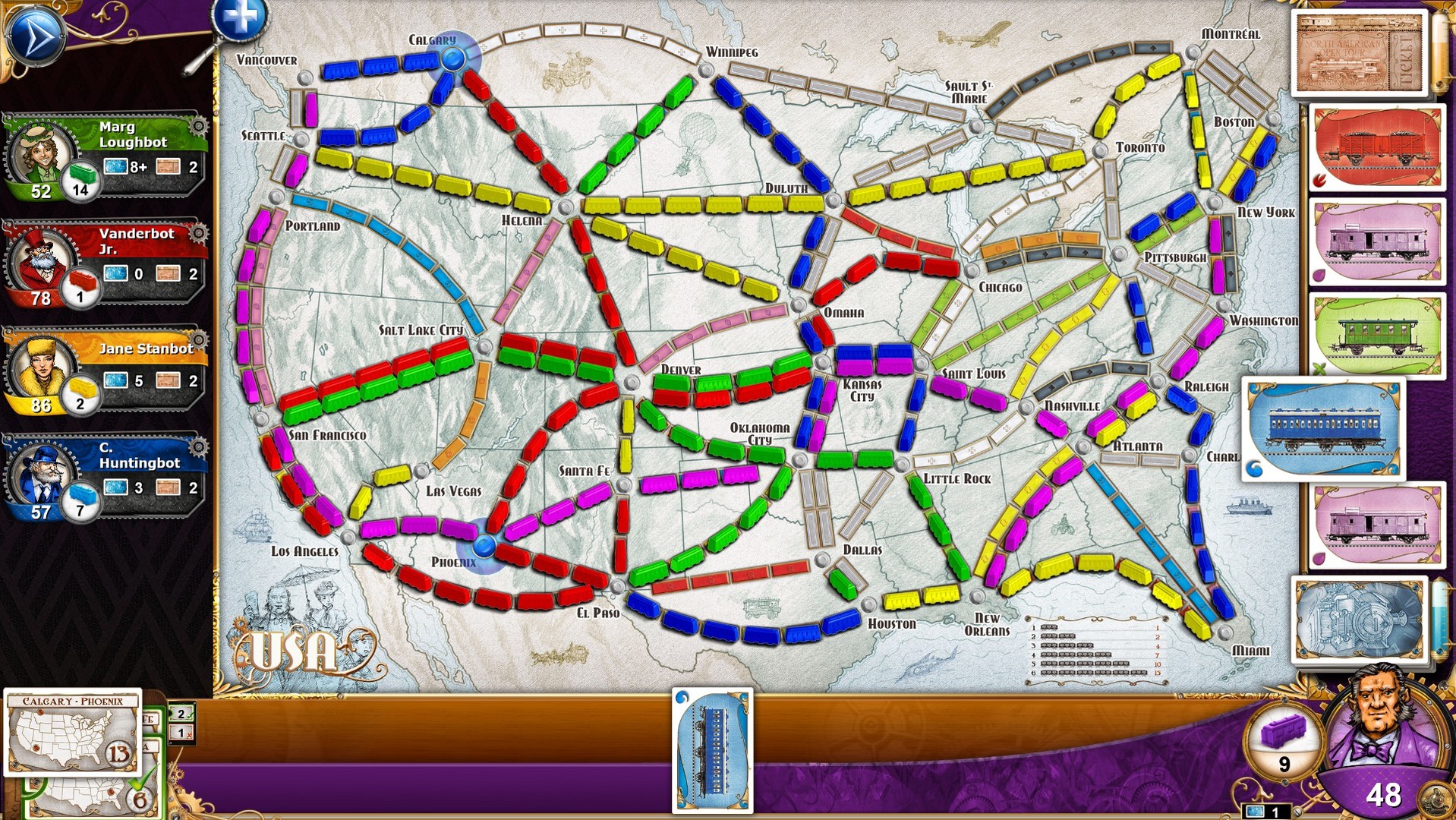
Hello, and welcome to the first Steam guide to the wonderful Ticket to Ride. First and foremost, it should be explained just what Ticket to Ride is! Ticket to Ride is the 2004 Spiel des Jahres award winning boardgame from Days of Wonder, created by legendary boardgame designer, Alan R. Moon. The Spiel des Jahres is, for those who don't know, essentially the Academy Awards for boardgames. It's a big deal. It's like being given 'Boardgame of the Year'. (Although, it won many of those awards too!) Ticket to Ride is a turn by turn strategy game, using trains to make routes stretching across America, Europe, Switzerland or Asia. The game is played by 2-5 people, each competing to be the best Rail Baron by the end of the game, by playing trains, finishing tickets and getting points! If you are familiar with the rules already, please, continue to section 3 of this guide. If you are not yet familiar with how to play, there is a beginner's tutorial in section 2. I urge you all when playing Ticket to Ride, Have fun and play hard! Cazaron. Ticket to Ride is a game of strategy and chance, in which players take turns playing train cards in order to place carriages on the map, in order to complete set routes. Doing these things will score points, and at the end of the game, the player with the most points will be declared the winner. For those of you who are 'TL; DR' people, here's a breakdown: Do one of these each turn: 1. Pick up cards 2. Play trains 3. Pick up tickets Now, for the rest of you, here's how Ticket to Ride works: Playing Ticket to Ride is broken down into a few key aspects, each of which must be understood in order to play the game effectively. 1. Train Carriages. Initially, a player has 45 train carriages (henceforth, 'trains'), of which they may use to 'claim' routes on the map. Things to note with trains are: - You may NOT use more than 45 trains, once you've used them, they're gone. - Once any player is down to 2 or less trains, it signals the 'Last Turn' phase of the game. - Trains may only be placed when a player uses the correct number and colour of Cards to claim the route. - A 'Four space route' (henceforth, 'four route' or sometimes simply 'four') such as Miami-Charleston on the map above requires the player to hand in four cards of the one colour (in this specific case, they must be four pink cards) in order to play four trains on that route. 2. Destination Tickets. Destination Tickets, or simply, 'Tickets', are dealt at the start of the game to players. Initially, 3 cards are dealt, of which you must take at least two. You must then use your trains to claim routes connecting the two cities shown on your tickets. Things to note with tickets are: - Any completed tickets will count for your score at the end of a game. - Any unfinished tickets will count against your score. - You do not have to finish your current tickets in order to pick up more. 3. Train Cards. Train Cards, or 'Cards' are present as a 'currency' system. Initially, you are dealt four cards. In order to place your trains on the board, you must trade in cards based on the route you wish to claim. Things to note with cards are: - To claim a route, you must play the same number of cards as there are on the route you wish to claim. - Cards must be traded in in groups of the same colour. To claim a 6 train grey route (Winnipeg-Sault St. Marie, for instance), you must trade in six cards of the same colour. - 'Wild' Cards or 'Locomotives', as they are called, count as ONE of any colour card you want. - If three Locomotives are face up on the table at any one time, they are placed on the bottom of the deck, along with the other two cards that are face up, and a new set of five is dealt to the table. 4. Routes. Routes are claimed through the trading in of cards and the expense of trains. Routes score differently based on how many trains were used to claim the route. The scoring table is below: As you can see, longer routes score more points. 5. Turns. A single turn consists of a player performing ONE (and ONLY one) of the following actions: 1. Drawing Cards A player may draw: - TWO face up non wild cards OR - ONE face up wild card OR - ONE face up non wild card AND ONE 'Blind Draw' card OR - TWO 'Blind Draw' cards. 2. Drawing Tickets A player drawing tickets must take the top three tickets in the pile. Once a player has drawn three tickets, they must decide how many they wish to keep. They MUST keep at least one. 3. Playing Trains A player, if they are able to trade in the right number and colour of cards, may play trains on the desired route. Once any of these actions has been completed, play moves to the next player. Ticket to Ride is a 'Five minutes to learn, Ten minutes to understand, but a lifetime of playing' game. For strategies on understanding the game better, please go on to section three. The best way to becoming a better player is to know all the tickets that the game possesses. This sounds difficult, but it turns out, after a few games, you'll be right on top of it. This is the board for the USA map. There are thirty tickets. These are: (Courtesy of jkstam.tumblr.com) Los Angeles to New York (21) Duluth to Houston (8) Sault St. Marie to Nashville (8) New York to Atlanta (6) Portland to Nashville (17) Vancouver to Montréal (20) Duluth to El Paso (10) Toronto to Miami (10) Portland to Phoenix (11) Dallas to New York City (11) Calgary to Salt Lake City (7) Calgary to Phoenix (13) Los Angeles to Miami (20) Winnipeg to Little Rock (11) San Francisco to Atlanta (17) Kansas City to Houston (5) Los Angeles to Chicago (16) Denver to Pittsburgh (11) Chicago to Santa Fe (9) Vancouver to Santa Fe (13) Boston to Miami (12) Chicago to New Orleans (7) Montreal to Atlanta (9) Seattle to New York (22) Denver to El Paso (4) Helena to Los Angeles (8) Winnipeg to Houston (12) Montreal to New Orleans (13) Sault St. Marie to Oklahoma City (9) Seattle to Los Angeles (9) In the 1910 expansion, some standard tickets have been modified in value (Thanks to The Raven): Los Angeles -> Miami: Reduced from 20 to 19 Los Angeles -> New York: Reduced from 21 to 20 Sault St. Marie ->Oklahoma City: Reduced from 9 to 8 Seattle -> New York: Reduced from 22 to 20 Knowing which tickets to select is vital in any game. Say, for instance, you drew Seattle-New York, Los Angeles-New York and Los Angeles-Chicago. Knowing the synergy of LA-NY and La-Chi dictates that you have to at least take those two, as you can finish Los Angeles-Chicago simply by completing Los Angeles-New York, if you go via Chicago. However, the question remains, do you take Seattle-New York as well? Being the highest scoring ticket in the game, it's so tempting to take it. In this case, you should, as all you would have to do to complete it is connect Seattle to your Los Angeles-New York train route. So that's all well and good, you know to look out for tickets that complement each other at first. But playing your trains to complement other tickets? Here's what I mean. Traditionally, completing Los Angeles-New York opens up the following tickets that if you draw, can be easily completed: Los Angeles-Chicago. Denver-Pittsburgh. San Francisco-Atlanta (is slightly harder, but very doable) Portland-Nashville (is harder, but also very doable) Seattle-New York (requires going to Seattle, but you will want to) Seattle-Los Angeles Finishing Seattle-New York allows easy completion of Vancouver-Montreal. Suddenly, you have a lot of tickets, and a lot of points. Memorise the tickets, so you can know where to best play your trains. This is probably the most important thing. Don't play routes you don't need, with the only exception of 'by playing this route, I would finish this ticket if I drew it'. However, the one thing that should be duly noted is that you should only attempt to play routes you don't need for the tickets you currently have if you have the trains to spare. By this, I don't mean that you can finish your routes. I mean tha
ИсточникGHub Platform · автор10.09.2026, 14:08:15
Hello, and welcome to the first Steam guide to the wonderful Ticket to Ride. First and foremost, it should be explained just what Ticket to Ride is! Ticket to Ride is the 2004 Spiel des Jahres award winning boardgame from Days of Wonder, created by legendary boardgame designer, A…
Войдите, чтобы писать в группе