Running the Steam Engine Properly
GHub Platform · Гайд · 0 ответов · 2 просмотра
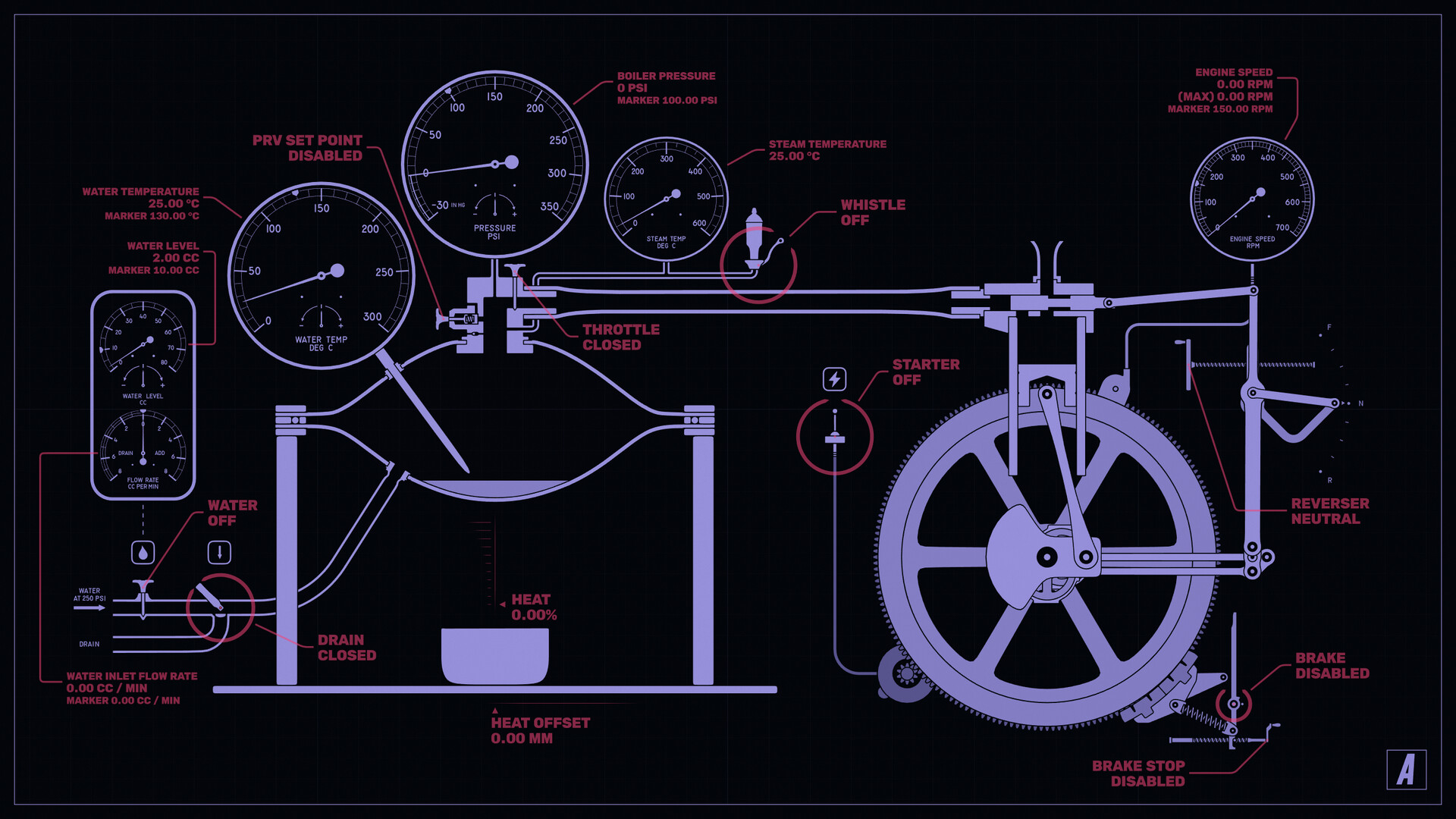
Steam Engine Simulator simulates a simple steam engine. I think it was originally based on a toy steam engine from stirlingkit.com . As such, the engine has no governor, no injector, and only the most basic controls. While this makes it simple to understand, it also makes the engine tricky to operate because it's fundamentally unstable and requires manual control of all processes. You can't just set it and forget it; constantly adjusting it is where a lot of the "fun" of the game comes from. There is one way to run the simulated engine in a stable configuration, which is to run it with an empty boiler and high heat, where incoming water instantly flashes to steam. In reality, that's a good way to damage or destroy the boiler and to injure or kill bystanders. Indeed, this approach is untenable in the new DLC because it simulates damage to the boiler from overpressure. So, this guide is focused on running the engine "properly", by which I mean running it within normal tolerances. This guide is currently in the process of being updated for the new DLC. Some parts may be missing, incomplete, or just weird. These are the controls and indicators of the simulated steam engine. Controls Water valve The water valve controls the size of the aperture allowing water to enter the boiler. It does not directly control the amount of water entering the boiler; that is a function of the water valve position and the boiler pressure compared to the water pressure. If the water supply pressure is 100 PSI, no water can enter when the boiler pressure is 100 PSI or above, and very little water will enter when the pressure is close to 100 PSI. In the DLC, you start out with a 50 PSI water supply that you can gradually upgrade to 250 PSI. The base game now gives you 250 PSI all the time. (Formerly, it was only 100 PSI, which made running the engine with or without water inflow an important choice to make.) Real steam engines used for industrial work have injectors, which use steam from the boiler to boost incoming water pressure above the boiler's own pressure, allowing water to enter even when the boiler is highly pressurized, but in the game you won't be able to sustainably run the engine at or above water pressure. This determines, in part, how we must run the engine. The cold water entering the boiler also cools down the hot water that's already in there. If you're not careful, you can cool the water excessively, ending steam generation and killing the engine. Note that when initially filling the boiler, the air inside the boiler will have no place to go - preventing you from filling the boiler - unless you use the throttle, relief valve, or steam whistle to let it out. Heat level The heat level controls the amount of heat dumped into the boiler. This is normally used to boil liquid water into steam, but depending on the horizontal heat offset and the level of water currently in the boiler, it can also be used to more or less directly heat the gaseous steam within. It should generally be adjusted to achieve a constant water temperature. Heat offset The heat offset has two purposes. Outside the DLC, it's largely just a gimmick that works as follows. The horizontal heat offset allows you to control how much heat goes into the liquid water versus how much goes into the steam. This only works when the water level in the boiler is low enough that the steam is in direct contact with the base of the boiler. Hotter steam translates into higher steam pressure and engine efficiency, but for a given heat level, more heat dumped into the steam means less heat dumped into the water, resulting in lower steam mass and thus lower steam pressure. The two effects partially cancel each other out, but the net result is usually a trade-off between fuel efficiency and water efficiency. Directing more heat into the water generally results in less fuel usage and more water usage, while directing heat into the steam results in more fuel usage and less water usage, all else being equal. Given that water is free and fuel is expensive, and that high pressure can damage the boiler, there's no point to superheating steam in the DLC, so its primary purpose is to get a brief burst of power to help set new RPM records outside the DLC, if you enjoy that. The second and more useful purpose of the heat offset is to bypass the insulating and damaging properties of sediment that accumulates in the boiler in the DLC. Before you upgrade to a high-level water filter, contaminants in the water may precipitate out as sediment. This sediment insulates the bottom of the boiler, slowing heat transfer, and hot sediment will damage the boiler structure if it exceeds the maximum temperature of the boiler material. If you mouse over the bottom of the boiler, the game will show the temperature of the sediment. You can and should offset the heat until the sediment temperature drops to the point that it's not damaging the boiler (i.e. until the text is no longer displayed in red). If you offset the heat, you may need to add more water so that the heat is still directed into water rather than steam. Throttle valve The throttle valve controls the size of the aperture allowing steam to flow from the boiler to the cylinder. It's not a simple matter of "more throttle means more power". For a given configuration of the engine, there is a throttle position that maximizes power, and beyond that the engine power is actually reduced. This is apparently because the valve design of the cylinder causes the exhaust stroke to partially fight against the incoming steam, and beyond a certain point more incoming steam slows the cylinder, reducing engine power and wasting fuel. This is still the case post-DLC, but it's much less significant; with the addition of the new reverser control and the change to the valve design, it's simpler and easier to leave the throttle at 100% and control steam flow with the reverser, although you can control both to optimize performance. Generally speaking, to achieve a given power output, you can use many different throttle positions, but a more closed throttle will require higher boiler pressure and less fuel. Some typical data are listed below, depicting power generated with constant fuel consumption, at 75% reverser, at the engine's peak power speed. Throttle Power / Efficiency Boiler pressure Water temperature Controls (continued) Reverser The new reverser control, introduced at the same time as the DLC, changes the valve timing in such a way as to control how fast and for how long steam is allowed to enter the cylinder on each power stroke. (It can also reverse the engine, but that's mostly useless in the game.) Thus, it does the same basic job as the throttle, but in a way that's more effective and quicker to respond to changes. As a result, it's generally easiest to leave the throttle at 100% while you control the steam with the reverser, but you can gain efficiency by using both controls. Just like the throttle, to achieve a given power output, you can use many different reverser settings (although the range is much smaller). Unlike the throttle, where it's more efficient to use the smallest value that gets the job done (ignoring boiling pressure limits), efficiency typically peaks around 70 to 80% reverser - 70% when the engine is running slowly and 80% when the engine is running quickly. Above that, efficiency slowly declines. Below the peak, however, efficiency declines more steeply, depending on engine speed. See the table below, which gives approximate power and efficiency for when the steam engine is running fast (near peak power), at a medium speed (near peak efficiency), and at a slow speed (about half peak efficiency speed): Reverser Power (fast) Efficiency (fast) Power (med) Eff. (med) Power (slow) Eff. (slow) Starter motor The starter motor allows you to manually rotate the flywheel to prepare the engine for starting. By default, the game starts with the p
ИсточникGHub Platform · автор15.09.2026, 16:25:19
Steam Engine Simulator simulates a simple steam engine. I think it was originally based on a toy steam engine from stirlingkit.com . As such, the engine has no governor, no injector, and only the most basic controls. While this makes it simple to understand, it also makes the eng…
Войдите, чтобы писать в группе