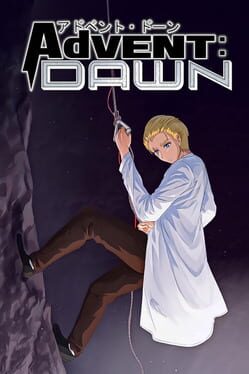
Advent: Dawn
Seven strangers descend beneath a remote island. A suspiciously timed cave-in seals the way out. And somewhere in the dark, the cave begins to whisper.
Dr. Atlas Everly is a neuroscientist invited to research a strange property of a unique crystal found deep within an island cave. But when the expedition is cut off by a sudden cave-in , Atlas and six others are left trapped underground with no clear way out. At first, survival is the only priority. But the cave is not what it seems...
The deeper the group goes, the more strange clues begin to appear — and the more difficult it becomes to tell whether the danger is coming from the cave, from the group, or from the fear growing between them. To escape, Atlas must get closer to the other survivors, uncover what they know, and follow each route to a different fragment of the mystery.
A MYSTERY TOLD ACROSS CHARACTER ROUTES:
Each route draws Atlas closer to a different companion, and through a different part of the cave. No single route gives you the full picture. To understand the truth, you’ll need to compare what you learn across multiple paths.
USE THE FLOWCHART TO RETURN TO KEY DECISIONS, EXPLORE ALTERNATE BRANCHES, AND SEARCH FOR THE ROUTE THAT LEADS TO THE TRUE END:
Advent: Dawn is a character-driven sci-fi mystery visual novel that blends psychological suspense, emotional storytelling, and a moving original soundtrack. Similar in genre to classics like Zero Escape, Umineko, Ever17, and Steins;Gate , it is built for readers who love intricate mysteries, difficult choices, intimate character routes, and twists that reframe everything that came before.
KEY FEATURES:
A flowchart built for mystery-solving: Jump back to key decisions, test theories, and uncover locked paths.
Light puzzles woven into the story: Solve light puzzles and riddles that are central to the core mystery of the cave.
Partial Voice Acting: Key scenes are voiced using a combination of voice actors and speech synthesis, with mouth animations and optional voice blips for unvoiced dialogue.
Original Soundtrack: A fully original soundtrack from composer Caleb Coles.
Branching routes leading to a True Ending: Your choices unlock character routes, alternate outcomes, and the full truth behind the cave.
Mystery, Myth, Murder & Mind Games: Themes of identity, memory, and ancient symbolism are woven into a suspenseful sci-fi mystery of survival, suspicion, and buried truth.
Length: Standard read: 12-16hrs. Methodical read: 16-22hrs. Speed read: 9-12hrs.
Whether you're here for the heart, the tension, or the high-concept twists, Advent: Dawn invites you to descend—and decide .
Advent: Dawn is set in the same universe as The VII Enigma , but it is a standalone title—you don’t need to have played the previous game to enjoy this one. That said, fans of our earlier games can expect some tie-ins and Easter eggs along the way.
Wishlist now and join us on the Discord for updates leading to release.
Системные требования
Минимальные
- Minimum:
- OS *: Windows 7 or newer
- Processor: 2.0 GHz or faster
- Memory: 4 GB RAM
- Graphics: DirectX 11 compatible GPU
- Storage: 3 GB available space
Рекомендуемые
Данные пока не загружены
Отзывы
Steam · Positive
Все отзывы в Steam18 положительных из 21 отзывов
Игрок 8165Не рекомендует30 ч в игре
Strange Case of Mr Frankenstein What a strange playthrough this was. Took me a while to get through it, because it felt as if the game was holding a distorting mirror before me all the way to the abyss, distracting me with uncanny familiarities and slowing down my progress. For I was stopping every other step and writing down all the odd coincidences and synchronicities, checking if my perception had gone haywire, if I contracted some weird psychosis from all that purple glow. The feeling of déjà vu was at times too much, and I wasn't always sure if that was a good or a bad thing. Sometimes it felt as if I was under a neurological experiment, testing if I can be manipulated by all the bizarre recalls; trying to force resonance on me by stuffing the game with all the things that should appeal to a certain kind of player - on paper. But I'm getting ahead of myself. Let's start from the beginning. Advent: Dawn is Spire's third visual novel in this loose pastiche of classic Japanese VNs, and in some ways, it's their best one yet. In other ways, it's the most frustrating of them all. It takes place in the Enigma universe, but you don't need to have played that first game before this one as it's only a loose sequel; but now in that common anime package we've seen in Synesthesia. After the Enigma's grey dystopic ground surface world, and soaring to the bright colourful heights of cosmological abstractions in Synesthesia, we're now going underground, descending into the dark mythic underworld of shadows and ghosts, plunging deep into the womb of the Mother Earth. https://steamcommunity.com/sharedfiles/filedetails/?id=3768068245 As you can imagine, the setting alone almost dictates the change of genre as well, as being confined to suffocating enclosures with no exit is ripe for descending not just the circles of geological history, but also sanity; playing with tension, paranoia, claustrophobia, being face to face with shadow(selves) and ancient archetypes. In other words: mystery and psychological.. stuff. Right off the bat I've noticed better pacing than before and almost no, or very little, technobabble (there's no encyclopedia this time either). Needing to keep things hidden and veiled certainly helped reign in the more excessive tendencies towards the rigidly studious and technical exposition/info-dump in the form of sudden scientific lectures in the middle of the plot, of which Enigma was the worst offender. Make no mistake, this is still sci-fi in a way, with lots of intriguing concepts; which is again the biggest strength of this series of visual novels of ideas. I found the mystery build-up engaging, and the route structure had a big hand in it. Across 3 games, routes have been slowly deepening; there are now actual multiple routes burrowing deeper than before, into the forking tunnels, passages, caverns. Well, there is an attempt at illusion that you can get lost in these crevices and crannies, but actually you're guided by the narrative and semi-enforced order of play, ensuring you follow the predetermined story beats. Which are scattered throughout the cave, including different flavour and theme per route, various puzzles (yes!) - all carrying pieces of the mystery, paving the way for the true route. Sadly, the ensemble cast is woefully underutilised, as you can only take the girls spelunking, greatly cutting down any promise of really going into (mis)trust between characters.1 "I can't stop these forced echoes" So far, so good, so what's with that dramatic opening? For the full understanding, I suggest you read the uncut review/analysis linked below. Suffice to say, I can see what the author was going for, new things were tried; but the execution is very uneven. The focus is more on the atmosphere this time that the inconsistent writing just can't carry. It goes from modestly evocative to stepping well into purple prose; which then becomes accented by relentless repetition.2 Every route has a theme, and to make sure you really get it, its main word is gonna be repeated ad nauseam to really lay it on thick. Beating people over their heads with technobabble is one thing, but doing the same with theme-babble is simply unbearable. Still, psychobabble was even worse, to the point that I even wished for technobabble to save me. https://steamcommunity.com/sharedfiles/filedetails/?id=3768067564 There are also phrases that mean meaning (translation: they mean nothing). Many such cases that seem like mixing words to sound 'literary' while sacrificing making sense. It looks like an attempt at emulating a certain kind of 'hauntingly poetic' writing by copying only the most surface layer, because it sounds 'cool', without intuiting why it works and resonates in your inspiration, but not in a superficial imitation - so you end up with clunky pseudo-poetic purple nonsense. There are numerous examples of this gesturing towards some deep feeling and substance instead of arriving at it more organically; so rather than reaching those pretend depths, the prose stays firmly on the surface, because that's the only layer it can simulate. More on psychobabble, purple prose; literalness; mimicry; butchering for 'clever' gotcha twists, read in >>the full text with detailed analysis. Especially frustrating is just how borrowed and mimicked this all feels, how strangely mixed and Frankensteined. To be sure, even Spire's previous games were eclectic pastiche, unabashedly taking from other works and closely following their recipes, but the scooping from many soups has reached a whole other level in this game. It's one thing to say one wears their influences on their sleeves, but quite another for them to be so obviously on the nose, to the point of pulling them, like wool, over your eyes, that made me think: where is the line between inspiration and imitation? I think this VN crossed it too many times. I can't remember when was the last time I played/read something that reminded me of so many games I played (and wrote about): words, phrases, images, visual motifs, used in very similar contexts. I thought I was having a perpetual déjà vu. It's the darndest thing.3 Regardless of the fact that I enjoyed parts of this VN and see what it tried to do, if I'm constantly thinking of other games while playing, then this is always going to feel more or less derivative in my mind. A flipside of all those déjà vu-s; instead of building connection, they start to create aversion. Something to think about, especially when this kind of mechanical combining and recombining has a certain artificiality to it; the Frankenstein monster is haphazardly stitched from disparate parts, but poorly synthesised, nor transformed into its own thing; its stitches are protruding, they want to poke my eyes out. The unholy hybrid is buzzing so loudly with others' voices, it's deafening, that it's hard to distinguish the creator's own authentic voice. Therefore, the amalgam will always feel disjointed, sentenced to forever be less than the sum of its parts. https://steamcommunity.com/sharedfiles/filedetails/?id=3772973569 Perhaps the best embodiment of all this is in the title - Advent: Dawn. Isn't it kinda *almost* like the SciADV titles? I caught myself reading it as Advent;Dawn.4 So close, but not quite. And that's how I see all these other perception tricks, all the mirroring, echoing, pantomiming, shadowing, simulated resonances, and most importantly, the game's merit. Close but not quite. Too much uncanny in the space between. And I'm afraid this gap is wider than it appears.. it might as well be a chasm ... because: "True resonance cannot be forged". Follow Drugoja In The Dreaming out of the purple fog