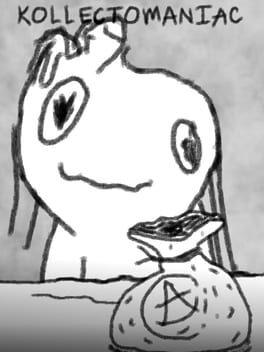
Kollectomaniac
Kollectomaniac - это игра про управление магазином в лесу на бревне. Вы работаете на человека по имени Дларлнод, вашего хозяина.
«Работайте в моей лавке бесплатно, все, что вам нужно делать, - это платить мне арендную плату каждые четыре дня».
-Dlarlnod Вы покупаете товары у странных людей, которых называют ходоками.
В игре девять ходоков, каждый из которых обладает ярко выраженными и немного случайными личностями.
Эти характеры меняют их своенравность, влияют на стоимость предметов и придают каждому ходоку особое настроение.
Каждое прохождение игры начинается одинаково: вы покупаете свои первые предметы, а оставшиеся деньги тратите на «Стенд», который позволяет продавать эти предметы ходокам.
Накопив денег и узнав среднюю цену предметов, вы сможете потратить в магазине все свободные центы!
Червяк продает различные предметы, включая шляпы, механические «трекеры статистики» и предметы, которые вы можете использовать во время фазы покупки и продажи в игре.
Какова цель? Выжить. Каждые пять дней проводится день сбора денег. Если вы не доживете до дня сбора: Вы должны сдаться...
Системные требования
Минимальные
- ОС: Windows 10 to 11
- Процессор: Intel Celeron N3450
- Оперативная память: 500 МБ ОЗУ
- Видеокарта: Integrated Graphics
- DirectX: версия 9.0
- Место на диске: 750 МБ свободного места
- Поддержка VR: None
- Примечание: Highly recommended to run on an SSD and not a hard drive. Saving and loading may incur performance hits.
Рекомендуемые
- ОС: Windows 10 to 11
- Процессор: Intel Core i3 1220P
- Оперативная память: 800 МБ ОЗУ
- Видеокарта: Integrated Graphics
- DirectX: версия 11
- Место на диске: 750 МБ свободного места
- Поддержка VR: None
- Примечание: Highly recommended to run on an SSD and not a hard drive. Saving and loading may incur performance hits.
Отзывы
Steam · 8 user reviews
Все отзывы в Steam8 положительных из 8 отзывов
Игрок 1798Рекомендует10 ч в игре
Kollectomaniac, developed by Akmacdondon and published by Akmac Industries, is a strange and experimental blend of shop management, exploration, and roguelite structure set in a surreal post-apocalyptic world. It immediately stands out for its tone, presenting a setting where familiar ideas like trading and survival are filtered through bizarre rules and unsettling transformations. Rather than guiding players through a traditional narrative or clearly defined systems, it invites them to adapt, experiment, and survive within a world that feels unpredictable and often deliberately opaque. The main gameplay loop revolves around running a small trading operation while trying to meet recurring financial obligations. Every few in-game days, players are required to pay rent, and failing to do so brings consequences that can end a run. This structure creates a constant sense of pressure, as each decision contributes to whether you can sustain your operation long enough to continue. Buying and selling items becomes more than a simple exchange; it turns into a careful balancing act between risk and reward, where pricing, timing, and resource management all play a role in survival. What gives the game its distinctive character is how it layers this economic system with unpredictable elements. Customers behave in unusual ways, items may have hidden properties, and the world itself seems governed by rules that are not immediately clear. This encourages players to experiment and learn through trial and error, gradually uncovering how different mechanics interact. The roguelite structure reinforces this process, as each run provides an opportunity to apply what has been learned while dealing with new variations and outcomes. Beyond the core shopkeeping loop, the game expands into a variety of side activities that add texture to the experience. Players can explore surrounding areas, interact with strange systems, and engage in small tasks or mini-games that break up the routine. These additions contribute to the game’s surreal atmosphere, making it feel less like a straightforward simulation and more like a collection of interconnected oddities. However, these elements are not always fully integrated into the main progression, and at times they can feel like separate ideas rather than parts of a cohesive whole. The atmosphere is one of the game’s strongest features. Its combination of bleak survival themes and offbeat humor creates a tone that is both unsettling and oddly engaging. The world feels intentionally strange, with its transformed inhabitants and unexplained systems adding to a sense of mystery. This approach rewards curiosity, as players are encouraged to explore and piece together how everything works, even if the answers are not always immediately satisfying. At the same time, the game’s early access state is noticeable in its current form. While the core concept is compelling, the execution can feel uneven. The main loop, though initially engaging, does not change significantly over time, which can lead to repetition during longer sessions. Some mechanics lack depth, and certain features feel underdeveloped, suggesting that the game has not yet reached its full potential. The lack of clear guidance can also make it difficult for new players to fully understand how to progress, especially in the early stages. Despite these issues, Kollectomaniac offers moments where its systems come together in a satisfying way. Successfully managing resources, meeting deadlines, and navigating the game’s unpredictable elements can create a sense of accomplishment that keeps players engaged. Its unconventional design and willingness to embrace oddity give it a unique identity that sets it apart from more traditional management or roguelite games. In the end, Kollectomaniac is a creative but rough experience that is defined more by its ideas than its polish. It presents an intriguing combination of mechanics and atmosphere that can be rewarding for players who enjoy experimentation and discovery, but its limitations prevent it from fully realizing its potential. As it continues to develop, it may grow into a more complete and refined experience, but in its current state, it remains an interesting and occasionally compelling work in progress. Rating: 6/10