Overshoot
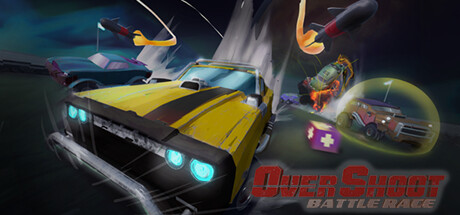
OverShoot Battle Race, вдохновленная старыми изометрическими аркадными гоночными играми, представляет собой чрезвычайно увлекательную гоночную игру, которая возвращает эмоции от игры в боевые гонки в одиночку или с друзьями. Продолжайте преследовать противника, пока он не взорвется. Безумный геймплей со множеством взрывов Аркадная графика в старом стиле, вызывающая чувство ностальгии.
Усовершенствованная система искусственного интеллекта сделает каждую игру уникальной. Приобретайте новые машины, улучшайте свою машину и покупайте много оружия. До 4 игроков на локальном общем разделенном экране.
Многопользовательский режим Создайте свои собственные серверы Присоединяйтесь к нашей группе разногласий и участвуйте, оставляя отзывы и идеи.
Системные требования
Минимальные
- Minimum:
- OS *: Windows XP
- Processor: Core I3
- Memory: 4 GB RAM
- Graphics: NVIDIA 9800 GT 1GB / AMD HD 4870 1GB
- Storage: 8 GB available space
- Additional Notes: Attention : The game provide the the possibility to play with older graphic board ( 256 MB NVidia / AMD Radeon / Intel HD 3000, HD 4000 ) or even without a dedicated graphic board, nonetheless, you will need to play with reduced quality and resolution to having a better experiênce, especially when playing with 4 players in split screen mode
Рекомендуемые
- Recommended:
- OS: Windows 10
- Processor: Core I5
- Memory: 8 GB RAM
- Graphics: NVIDIA GTX 660 2GB / AMD HD 7870 2GB
- Storage: 8 GB available space
Отзывы
Steam · Mostly Positive
Все отзывы в Steam53 положительных из 73 отзывов
Игрок 1798Рекомендует15 ч в игре
OverShoot Battle Race is an arcade racing game that mixes high-speed competition with vehicular combat, giving each event more to worry about than simply reaching the finish line first. Developed and published by OnlineObject, it takes inspiration from classic isometric racers and builds its identity around drifting, weapons, vehicle destruction, upgrades, and chaotic competition. It is not trying to recreate realistic motorsport. Instead, the focus is on accessible driving and the simple pleasure of attacking rivals while fighting to stay ahead of the pack. The isometric viewpoint immediately gives the racing a distinctly retro character. Rather than positioning the camera directly behind the vehicle, the elevated perspective allows players to see more of the surrounding track and nearby competitors. Steering and judging corners can require an adjustment period if you mainly play conventional racing games, but the viewpoint complements the arcade design. Drifting is especially important when maintaining momentum through turns, while awareness of rival vehicles becomes equally necessary once weapons start entering the equation. Combat is where the game separates itself most clearly from an ordinary racer. Opponents are targets as much as competitors, and destroying another vehicle can be just as satisfying as executing a clean overtake. Weapons introduce constant uncertainty because even a strong racing position can disappear when another driver launches an attack. Conversely, falling behind does not always mean the race is lost, since aggressive play can disrupt opponents and create opportunities for a comeback. Explosions and vehicle destruction give races an energetic quality that suits the intentionally exaggerated arcade atmosphere. Progression adds some substance beyond individual events. Additional cars can be acquired, vehicles can be upgraded, and weapons can be purchased, creating a straightforward cycle of competing and improving your equipment. These features encourage experimentation and provide goals outside of simply winning another race. The customization and progression systems are not intended to offer the enormous mechanical complexity of a simulation racer, but they fit the faster and more approachable nature of the experience. Computer-controlled opponents help support solo play, with AI behavior designed to make races less predictable. Because combat is integrated into the racing, opponents have the potential to create unexpected situations rather than merely following an ideal racing line. The single-player experience is therefore perfectly capable of delivering the core gameplay, although the concept becomes considerably more entertaining when human competitors are involved. Rivalries, surprise attacks, risky maneuvers, and last-second retaliation naturally become more memorable when another person is responsible for them. Multiplayer is consequently one of the game's more attractive qualities. Up to four players can compete locally using shared split-screen play, making it suitable for couch competition. Online PvP and multiplayer server functionality expand the possibilities beyond local sessions, while Remote Play Together provides another convenient way of experiencing its multiplayer-focused chaos. The accessible mechanics make it relatively easy for a group to understand what is happening without requiring everyone to master complicated racing techniques beforehand. Presentation favors functionality and nostalgic character rather than technical spectacle. The isometric environments, vehicles, effects, and explosions reinforce the feeling of an old-school arcade racer brought to modern PC hardware. Players expecting highly detailed cars, realistic environments, sophisticated damage modeling, or cinematic presentation will probably find the visuals modest. On the positive side, the lightweight presentation contributes to relatively approachable hardware requirements and keeps attention centered on the action rather than graphical realism. There is a respectable selection of supporting Steam features as well, including achievements, statistics, single-player and multiplayer options, Remote Play Together, and Family Sharing. These additions make the overall package feel more substantial than the simple premise initially suggests. Being free to play also makes experimentation easy, particularly for anyone uncertain whether the isometric controls or combat-heavy racing style will suit them. Steam Deck users should consider the game playable rather than assume a completely optimized handheld experience. Compatibility information indicates that it can run on Steam Deck, but it should not be treated as equivalent to an official Steam Deck Verified designation. Its relatively straightforward mechanics make handheld play feasible, although occasional adjustments or minor interface inconveniences may be possible. Players specifically buying or installing games for Deck use should therefore expect functional compatibility rather than guaranteed console-like optimization. The game's weaknesses mainly emerge from its intentionally uncomplicated nature. Players searching for realistic physics, detailed vehicle tuning, sophisticated racing strategy, or cutting-edge presentation will find limited depth here. Solo sessions may also become repetitive after extended play because the central loop remains focused on racing, fighting, unlocking equipment, and upgrading vehicles. Multiplayer alleviates much of that repetition because human opponents make each confrontation less predictable. Overall, OverShoot Battle Race is most enjoyable as a compact arcade combat racer that understands the appeal of speed mixed with destruction. Its drifting, weapons, upgrades, unlockable vehicles, AI opponents, local multiplayer, and online competition create an entertaining foundation without burying the player beneath complicated systems. It may lack the refinement and depth of larger racing games, but its retro perspective and aggressive racing formula give it a recognizable personality. Anyone nostalgic for old-school vehicular combat games, particularly players looking for something casual to enjoy with friends, may find plenty of entertainment in its explosive races. Rating: 7/10