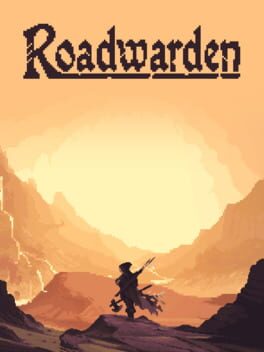
Roadwarden
YOU ARE THE ROADWARDEN
A brave stranger putting your life on the line to make a difference in this grim fantasy world . While most people would never risk a solitary journey through the wilder parts of the land, you willingly accept the struggle. You guard travellers, connect isolated villages, support merchants, and repel attacking creatures, bandits, or even undead.
TAKE THE PLUNGE
A powerful merchant guild has called on your services, sending you on a journey into the unknown planes of a mysterious peninsula in the hopes to expand the guild’s influence even further. Explore this world and gather as much information as possible to reveal the secrets surrounding the area. It’s a dangerous task, but an equally respectable one.
READY YOUR ARMORY
Roadwarden is an illustrated text-based RPG that uses isometric pixel art and combines mechanics borrowed from RPGs, Visual Novels, adventure games, and interactive fiction, such as inventory puzzles, dialogue choices, character abilities and progression, hit points, simple survival mechanics or quests restricted by in-game time.
FEATURES
Face the vast challenges of a hostile fantasy world in the 30-hour story-campaign
Create your own background, abilities, beliefs, and personality
Embark either as a warrior, mage, or scholar and define your character‘s attitudes
Immerse yourself in profound dialogues and sidequests with dozens of NPCs
Collect hints and investigate the true nature of this world
Системные требования
Минимальные
- ОС: Windows 10/7/8/8.1/XP/Vista (32 or 64 bit)
- Процессор: 2.4ghz Intel Core 2 Duo or equivalent
- Оперативная память: 2 ГБ ОЗУ
- Видеокарта: Nvidia 260 GTS or Radeon HD 4850 - 512 MB of VRAM or equivalent
- Место на диске: 2 ГБ свободного места
Рекомендуемые
- ОС: Windows 10/7/8/8.1 (64bit)
- Процессор: 2.66GHz Intel Core i7
- Оперативная память: 4 ГБ ОЗУ
- Видеокарта: Nvidia 460 GTX / Radeon 5770 - 1 GB of VRAM or equivalent
- Место на диске: 2 ГБ свободного места
Отзывы
Steam · Very Positive
Все отзывы в Steam4 934 положительных из 5 242 отзывов
Игрок 2369Рекомендует33 ч в игре
This isn't really a review. I mostly want to talk directly to the writer/developer, and to anyone interested in writing, about something very specific in Roadwarden's writing. I genuinely think it's one of the main things holding the game back from being something of a masterpiece. I'm not saying "write better." I'm trying to explain precisely where the writing loses its grip and what I think would make it stronger (in the hope that it's useful to anyone who reads this). First, the good: the worldbuilding is phenomenal. The world feels deep, interconnected, and full of things worth discovering. More importantly, the way you interact with it is unusually ambitious. Being a text-based game means you can have an enormous range of interactions without needing an animation or art asset for every possibility. You can type almost anything that comes to mind, and if it exists in the game and is even somewhat reasonable, the game reacts to what you're trying to do, even when it fails. The range of things you can attempt, and how far their consequences can reach, feels deeper than most RPGs I've ever played. Before getting into the issues, I want to stress that this isn't a problem with the writing all the time. I'd say the writing works fine for roughly 80% of the game, and toward the later parts I actually felt the prose become noticeably more competent and this problem occur much less often. It's precisely because the weaker moments stand out that I think they're worth pointing out. Spatial/Temporal Continuity and Embodiment This is the heart of my criticism: Roadwarden often gives me perfectly understandable individual details without giving me the relationships between those details that let me actually inhabit a scene. I can understand every sentence individually, yet still fail to build a clear picture of where I am, where everyone else is, how we got from one point to the next, or how one action leads into another. It's almost as though the game's isometric, distant visual perspective sometimes carries over into the writing. I feel less like I'm seeing the world through the Roadwarden's eyes and more like I'm a drone floating above the scene, or a god who can see everything at once. I know what the carpenter is doing, what the bird is doing, what someone across the room is looking at, and what happened somewhere else a moment ago, but I don't necessarily know what my character is seeing, how close these things are to him, or how his attention moves from one thing to another. It's an omniscient view of a scene where I want an embodied one. Characters sometimes seem to jump between physical states. One moment someone is sitting down, then they're picking at the ground, then they're looking at the sky, then they're back to sawing a plank. None of those actions are impossible. The problem is that I don't know what connects them. Why did they look at the sky? Did something above them catch their attention? Did my character look up because they did? Are they still sitting in the same place? The details are there, but the relationship between the details isn't always there. And that relationship is what lets the reader actually construct a scene rather than a list of things that happened. I just entered a scene where Helvius tells me to follow him. He dashes forward and hits a skeleton, then somehow we're back at the well and he's pointing out a corpse. I understand the sequence of sentences, but I don't really understand the scene. Where was I standing? Where was Helvius? Where was the skeleton? How did I follow him? Where was the well in relation to all of this? The game can be extremely specific about the appearance of a footprint or the color of a bird, yet sometimes the much more important information is missing: where everyone actually is and what is happening around me. The temporal side of this is just as important. Sometimes I press a button and a wall of text tells me that the next several minutes happened. I don't get to go through the event with my character; I get the event afterwards, already summarized. It creates a strange feeling of being slightly behind my own character, as though I'm reading a report about something that happened to him rather than experiencing it myself. This is something Disco Elysium and Citizen Sleeper do exceptionally well. It's not that they necessarily have less text. You can read enormous amounts of it. But they carry you through the writing paragraph by paragraph, moment by moment. Something happens, you process it, you react, something changes, and then you're carried into the next beat. You're continuously being brought along with your character instead of being handed the whole completed sequence at once. That's why I can read 500 pages of Blood Meridian and be completely absorbed, then read four paragraphs of Roadwarden and feel like I'm doing homework. I don't think that's a problem of length. It's a problem of how the writing carries me through time. The physical descriptions suffer from the same underlying problem. Someone taps their stomach while we're talking about something serious. Why? What emotion or situation is that supposed to convey? Sometimes it feels like the characters are simply doing something every few seconds because the prose needs to describe something. It's technically descriptive, and often quite specific, but specificity isn't the same thing as meaning. A physical action can make a scene feel more vivid when it is connected to the character's emotion, the environment, or what is happening around them. Otherwise it can feel arbitrary and actually interfere with the picture I'm forming. I don't think the answer is "use less description." I think it's use more purposeful description, and make the relationships between details do more work. Let the carpenter work on an intricately designed chair while we talk about someone he hates. Let him chip too hard when that person comes up, damage the chair, stop to examine what he's done, try to repair it, and continue the conversation. Now his work, his emotions, the physical environment, and the dialogue are all part of the same scene. The details have a relationship to each other. The same applies to larger events. When the carpenter gathers everyone in town, I'd much rather actually go through it with him: we leave the workshop, he gathers the villagers, someone asks a question, I choose whether to worry the crowd or calm them down, I see their reaction, and eventually we return inside. Instead, sometimes I choose one action and get a wall of text explaining that an entire sequence of events happened, after which I'm simply somewhere else. The game has made me the Roadwarden, but in those moments the narration turns me into a spectator of my own actions. And that's what makes this so frustrating: the game itself has already solved the hard part. It gives me a world worth exploring, an enormous amount of freedom in how I interact with it, and consequences that can reach far beyond a single conversation. I don't want less writing, and I don't want less description. I want the writing to make those things cohere. I want to know where my character is standing. I want to understand what he sees when he looks up. I want to follow someone through a space rather than simply be told that he led me somewhere. I want to experience a conversation changing a person's behavior, rather than watch their hands perform an unrelated gesture between lines of dialogue. I want to go through an event with my character instead of arriving at the other side of it in a paragraph. I don't need to see the whole world from above. I need to know where my feet are.
Игрок 0040Рекомендует43 ч в игре
objectively - i don't know. the art is good, the overall looks are good, the music is good, the vibes are good, the setting is good, the writing is good, not even naive and/or tropey. but it's a book. ya like books? here's Books 2: Electric Boogaloo. i.e. obviously not for everyone. for me though - the second i saw it, i knew right away that it's exactly what i need. the right type of "gameplay" (all text), the right amount of "combat" (a little, but more than in Disco Elysium), the right amount of RNG (almost none). played a fair few very text-heavy games in recent years, but straight up text-based, and without the constant dice rolls at every single freaking action - 't was the first one for me. and the option of straight up disabling the time limit by choosing the easiest difficulty is a *chef's kiss* cherry on top. and it felt oh-so-gоddamn-right!.. but why am i even telling you this? you know who you are. if it seems exciting to you - grab it, it's a good time, and a great price. an absolute gem of a game.
Игрок 3001Рекомендует18 ч в игре
Despite being only a text based game (with some cool pictures to help with inmersion) it hooked me up right away. Some of the missions make you go up and down all around, but there's always a reason that makes you want to see more about a quest will develop. There's many interesting characters and the world makes sense despite being only separated nodes. And the ends feels really rewarding (but also you can choose your own ending, it's very open) Also, the game allows for savescumming for if you want to get the better outcome on a storyline.
Игрок 1122Рекомендует28 ч в игре
What a stunning game. I loved it more than I expected! The characters are interesting, your choices really have an impact, the music is super nice and the exploration of the peninsula is quite the adventure. That being said, you have to read a lot BUT it's never useless trivia or boring stuff. Everything you find, every person/thing you talk to or about will give you information that might help you later. So it's never wasted time. As for time: on easy mode there is no time limit, normal 40 days and hard 30 days. I played as a scholar on normal and it was so much fun! Tip: if you catch a fish and you don't sell or cook it in the next days it will spoil and please wash yourself! ;p
Игрок 4083Рекомендует11 ч в игре
An amazing narrative text-based RPG with rich world building. The lore is deep and well developed, it feels like a session with a very good DnD Master that talks through the characters while also asking naturally flowing questions about the player's character's background. Answers to these questions are then woven into the narrative. This is masterful storytelling respecting player's agency. The only negative I d pick is the survival mechanics such as sleep and hunger management but these are my personal preference. Other than that this game is a great journey for every soul that enjoys text heavy games.
Игрок 6293Рекомендует17 ч в игре
Одна из лучших РПГ в которую я играл. Отличные описания, прекрасная имерсивность и великолепный баланс между личными возможностями и их пониманием. 10/10
Игрок 0640Рекомендует23 ч в игре
这游戏非常的出色。大世界、奇幻、冒险、成长,一款像素画风的小体量作品,依靠海量扎实的文本,为玩家铺展出一个足够逼真、充满烟火气的半岛世界 你不是什么屠龙英雄,只是一名远道而来的护路人,仅有四十天的时限,孤身踏入这片闭塞混乱的土地。奔走于散落的村落之间,走访村民、调解纷争、探查流言背后隐藏的秘密,打通各个聚落之间的道路。没有华丽的大场面战斗,所有的冲突、博弈、危机,都藏在一段段对话抉择之中。 每一个村镇都有着自己的困境与秘密,这里的 NPC 不是单纯给你派发任务的工具人。他们各有立场、私心与无奈,很多矛盾没有绝对正确的答案。你的每一次选择,都会实实在在影响村落的命运、人物的生死,整片半岛最后的走向。 同时它又带着严谨的生存压力:时间、食物、体力、装备都需要精打细算。赶路会消耗天数,资源分配不慎,很可能还没查清真相就迎来旅途的终结。这种限时探索的紧迫感,让每一次外出巡查都充满冒险感。 像素地图简约却氛围感十足,配合沉静的配乐,独自穿行在荒野林地、偏僻农庄的时候,那种荒凉、厚重的低奇幻氛围直接拉满。 小体量,大世界。如果你厌倦了流水线式的打怪升级,想要一场依靠对话、观察与权衡来完成的荒野冒险,非常推荐你来当一次护路人。
Игрок 6080Рекомендует33 ч в игре
Con un merecido 90% de reseñas positivas, este juego es una joya para la que solo necesitas un nivel medio de inglés y pasión por la lectura. La trama es más que decente. La única dificultad real para los no nativos es que algunos personajes tienen acentos muy marcados que modifican la ortografía de algunas palabras complicando la interpretación exacta del texto. Sin duda, ganaría muchísimo con un doblaje adecuado. Al mezclar aventura de texto, RPG y supervivencia, recomiendo jugar la primera partida en modo fácil, ya que elimina el límite de tiempo para resolver la historia y permite disfrutarla sin presiones. Su jugabilidad se sostiene en la toma de decisiones, la recolección de información, la resolución de algún que otro puzle y una constante gestión de recursos. Los combates se resuelven mediante tiradas de dados, obligándonos a explorar a fondo y a dialogar constantemente. Además, desde el principio elegimos un objetivo principal —denominado "ambición"— que determinará el éxito o fracaso de nuestro protagonista al final de la historia. Es vital cuidar tanto la salud como la protección y la apariencia física del personaje -especialmente en las ciudades y cuando comerciamos-. Contamos con tres clases iniciales que cambian el rumbo de la trama al destacar en habilidades diferentes. Por su parte, los gráficos pixelados, la música y los efectos de sonido logran una inmersión total sin restar protagonismo a la lectura. Para no perdernos, el juego nos ofrece un diario que actualiza las misiones, personajes y lugares descubiertos, un glosario para los términos específicos y, muy importante, un bloc de notas manual que no debemos descuidar para recordar algunos detalles.