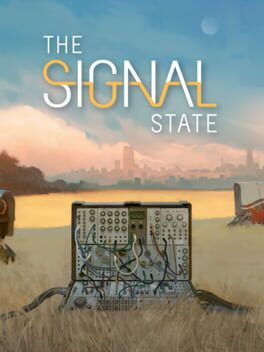
The Signal State
Поддерживайте сигнал
Управляйте входящим сигналом, перетаскивая по игровому полю уникальные модули и особые кабели. Оставьте свой след
Докажите, что вы лучший заклинатель линейных колебаний, разгадав более 40 головоломок и соревнуясь с другими игроками в турнирной таблице. Настраивайте интерфейс
Настройте интерфейс так, как вам удобно. Выбирайте из множества цветов и 3 разных стилей отрисовки кабелей! Синтезируйте прекрасное!
Испытайте новый уровень погружения благодаря работе студии Papernoise, которая разработала модули для Mutable Instruments, Hexinverter, WMD и других компаний. Режим песочницы для экспериментов
Свободный режим без ограничений. Дайте волю воображению! Конструктор головоломок
Смастерите свою головоломку или посмотрите, что выложили в Мастерской Steam другие игроки.
Системные требования
Минимальные
- ОС: Windows 7 / 8 / 10
- Процессор: 2.0 GHz
- Оперативная память: 2 ГБ ОЗУ
- Видеокарта: 1366 x 768
- DirectX: версия 10
- Место на диске: 500 МБ свободного места
Рекомендуемые
Данные пока не загружены
Отзывы
Steam · Very Positive
Все отзывы в Steam608 положительных из 701 отзывов
Игрок 1702Рекомендует8 ч в игре
It's a pretty neat zach-like, though a bit on the shorter side, even including the optional puzzles. It's also not that hard, I finished it in one sitting. There were like two or three optional puzzles that took me 30-60 minutes, but those were outliers, with most of non-trivial puzzles taking me around 15 minutes. In the game, you manipulate analog signals with various modules connected with cables. You have an input signal (or signals) and a target output, kinda like in Shenzhen I/O. Each of the modules does a specific "thing" with the signal, and you have to combine their effects to reach your goal. At the beginning, the game spends a pretty long time teaching you its mechanics and basic modules. It's probably a good thing, though it can be a bit tedious if you're a quick learner, or have some prior knowledge about logic gates and such. On the other hand, I feel like the game only tutorializes how the modules work on a pretty basic level. To give an early example, when the basic logic modules are introduced, you're only shown how they interact with binary signals, but knowing how they work with analog signals is essential to progress further in the game. Now, I do like figuring things out on my own, but i also think that a game's tutorials should spend more time on things that are harder to understand, rather than very basic ones. One thing that was left mostly unexplained, and the source of a lot of my confusion, was the way that the game's tick/timing system works. I kind of dislike it. On the surface, it looks like all of the modules work concurrently, you might even think that one module can do one "action" per tick, since that's kind of what it looks like when playing back your solution, but that's not really the case, If you make a feedback loop in some way, you'll see that a module will keep performing actions, until its input stabilizes. My main problem with it is that it's really hard to debug your solutions in that case, since you can only step forwards one "tick" and not one "action". It also leads to situations where a display on a module can show wrong information, which for me, caused a lot of confusion. The game has a hint system if you ever get stuck. They're a mixed bag. Sometimes you get something helpful, sometimes its an annoying "you can use the module that does X thing to do X thing" I really like the visuals. The modules look really stylish. A really nice touch is that each one of them has a manufacturer with a distinct visual style, it adds a bit of personality to the modules. It's also really fun to sometimes take a step back and look at the mess you've made with all the cables and stuff, though admittedly it rarely gets to that point. You usually have plenty of space for your solution, and dont need that many modules to solve a puzzle. The ending of the game was pretty abrupt. I don't mean the ending of the story, mostly I mean that the game ends on a relatively simple puzzle, there's no difficult end-game puzzle that tests your complete understanding of the game. There's also no extra optional puzzles after you beat the game. You just unlock the ability to use every module in previous puzzles. I feel like the last optional puzzle of the game would work better as a "capstone" puzzle, if it was unlocked after the ending. On the level select screen it sits right before the comparatively easier final puzzle, and that doesn't really sit right with me. All that being said, it's still a fun game and I liked playing it, though i'd probably recommend grabbing it during a sale.
Игрок 1798Рекомендует15 ч в игре
The Signal State takes an unusual subject and transforms it into a surprisingly compelling logic puzzle experience. Instead of relying on traditional switches, blocks, or environmental riddles, the game builds its challenges around modular synthesizer-style equipment, signal processing, and interconnected cables. Developed by Reckoner Industries and published by iterco and indienova, it creates a niche identity that immediately separates it from most puzzle games. Its post-apocalyptic agricultural setting may suggest something much larger in scope, but the real attraction is the satisfaction of understanding complicated systems and making them function correctly. The premise places the player in a world recovering from a devastating collapse. Agriculture and machinery have become essential parts of rebuilding society, and your role involves repairing electronic equipment necessary for that recovery. The story gives meaning to otherwise abstract technical puzzles without overwhelming the experience with excessive exposition. Conversations and narrative developments provide context for why these machines matter, but puzzle solving remains firmly at the center. This balance works because the game never pretends to be an expansive survival adventure. Instead, the ruined world gives its electronic troubleshooting an interesting sense of purpose. Every challenge revolves around receiving signals, manipulating them through different modules, and producing the required output. Players connect components using patch cables and gradually learn how each piece of equipment changes the information passing through it. The concept can initially look intimidating, especially when several modules and cables occupy the screen at once. Fortunately, the progression introduces the game's logic at a reasonable pace. Once the basic principles become familiar, previously confusing panels begin to resemble understandable machines rather than walls of mysterious electronics. The strongest moments arrive when a difficult puzzle finally makes sense. There is something extremely satisfying about examining a messy arrangement of inputs and outputs, experimenting with different connections, and eventually watching the system behave exactly as required. Later challenges demand increasingly careful reasoning as more components become involved. The player must consider not only where a signal travels but also how it changes along the way. This encourages genuine experimentation rather than random cable placement, and solving a complicated network can feel similar to debugging a small electronic system. Its visual presentation deserves considerable credit for making the concept convincing. Modules resemble physical synthesizer hardware, while cables stretch naturally between connection points and create increasingly elaborate networks. The interface has a tactile quality despite being entirely digital. Customizable cable colors and multiple cable-rendering options are particularly welcome because larger solutions can otherwise become difficult to read. The understated visual style also keeps attention on the equipment instead of surrounding the player with unnecessary effects. There are more than 40 main puzzles, providing enough challenges for the mechanics to evolve significantly. Leaderboards add another layer for players who enjoy optimizing their work rather than simply reaching a functional answer. A successful solution can often inspire another attempt to create something cleaner or more efficient. This makes completed stages worth revisiting, particularly for players who enjoy optimization as much as problem solving. The sandbox mode is another valuable addition because it allows experimentation without normal objectives getting in the way. Players can freely connect modules and explore how different configurations behave. The included puzzle designer goes even further by allowing custom challenges to be created, while Steam Workshop support provides access to community-made material. These features considerably improve longevity because the underlying system is flexible enough to support experimentation beyond the official campaign. The biggest obstacle is accessibility rather than quality. The Signal State is deliberately specialized, and players who dislike technical puzzles may struggle to connect with it. Its interface can become visually dense, and later challenges demand patience. The post-apocalyptic story also remains secondary, so anyone expecting a heavily narrative adventure may find the emphasis on electronic logic too dominant. Conversely, players who enjoy programming-style thinking, engineering problems, circuitry, automation, or optimization are much more likely to appreciate what the game is attempting. Steam Deck compatibility is rated Playable rather than Verified. The game can be played on Steam Deck, but the handheld experience is not completely seamless. Some interactions may benefit from touchscreen input or customized controls, and certain interface elements can feel small on the Deck's display. Because the game was designed around manipulating numerous small modules and connections, playing with a mouse on a larger screen remains the more comfortable option, though portable play is certainly possible. The Signal State ultimately succeeds because it fully embraces an idea that few other puzzle games explore. Modular synthesis is not merely an aesthetic pasted over conventional riddles; the behavior of signals, modules, and connections forms the foundation of the entire experience. Combined with its campaign, sandbox experimentation, leaderboards, custom puzzle creation, and Workshop support, there is substantial depth available for players willing to learn its unusual language. It is thoughtful, challenging, mechanically consistent, and exceptionally satisfying when a complex network finally comes together. Rating: 8/10
Игрок 0634Не рекомендует6 ч в игре
이 게임은 함부로 사지 마라 이게임도 독자적인 프로그래밍 방식을 갖춘 프로그래밍 퍼즐 게임인데 난이도가 높다. 엥 난이도 높으면 좋은거 아니야? 라고 하는 변태새끼들도 있을 수 있고 나도 그렇지만 이 게임은 퍼즐 자체의 난이도도 높은편이지만 문제가 난해해서 거의 출력값만 보고 그걸 구현하는 형식인데 심지어 가젯도 지들이 원하는것만 주니 사실상 정답이 하나인 문제다 나는 프로그래밍 퍼즐 게임이 좋은 이유가 다양한 답을 도출 할 수 있고 어떤 답은 이런 부분에서 최적화가 되어있고 이 답은 이 부분에서 최적화가 되어있네 하면서 비교 하는게 재밌다. 그런데 이게임은 그게 전혀 안되고 있다 그래서 비추준다.