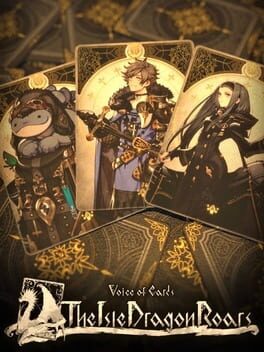
Voice of Cards: The Isle Dragon Roars
Voice of Cards: The Isle Dragon Roars is an RPG set in a world of swords and sorcery, told entirely through the medium of cards.
The story follows a self proclaimed hero as they set off to slay a recently awakened dragon, presented in the manner of a tabletop RPG and playing out through narration from the gamesmaster.
Enjoy an all new, yet appealingly nostalgic gaming experience from YOKO TARO (Creative Director), Keiichi Okabe (Music), Kimihiko Fujisaka (Character Design.)
* Please be aware that parts of the game which require an internet connection may cease to be supported at any point.
Системные требования
Минимальные
- Minimum:
- Requires a 64-bit processor and operating system
- OS *: Windows® 8.1/10 64-bit (ver.1909 and above)
- Processor: AMD A8-7600 / Intel® Core™ i3-2100
- Memory: 4 GB RAM
- Graphics: AMD Radeon™ R7 260X / NVIDIA® GeForce® GTX 650 (VRAM 2GB)
- DirectX: Version 11
- Storage: 5 GB available space
- Sound Card: DirectX® 11.0 Compatible Sound Card
- Additional Notes: Maximum resolution: 1920x1080, Monitor capable of 60FPS + required Supports Keyboard, Mouse and XINPUT gamepads
Рекомендуемые
- Recommended:
- Requires a 64-bit processor and operating system
- OS *: Windows® 8.1/10 64-bit (ver.1909 and above)
- Processor: AMD A8-7600 / Intel® Core™ i3-2100
- Memory: 4 GB RAM
- Graphics: AMD Radeon™ R9 270X / NVIDIA® GeForce® GTX 660
- DirectX: Version 11
- Storage: 5 GB available space
- Sound Card: DirectX® 11.0 Compatible Sound Card
- Additional Notes: Maximum resolution: 1920x1080, Monitor capable of 60FPS + required Supports Keyboard, Mouse and XINPUT gamepads
Отзывы
Steam · Very Positive
Все отзывы в Steam1 154 положительных из 1 437 отзывов
Игрок 6716Рекомендует11 ч в игре
Good game. It's a very experimental JRPG. The game itself has a very creative style (everything is cards - characters, equipments, npc's, items, skills, etc. - and the world is a tabletop). The story is decent. Bosses are easy (The only real difficult boss is the last one because he heals himself, everything else is mid or easy). The soundtrack is good also. The game is too short thou.
Игрок 2025Рекомендует3 ч в игре
Pros: Creative concept and great music. Cons: Combat can become repetitive. Conclusion: The whole concept of playing a turned base RPG through cards is very creative. The music score was great and I found myself sitting there just listening to it. Combat is random and can get repetitive since you have limited actions you can do on your turn. The game is recommended if you like turn base RPGs and want a fresh way to play.
Игрок 1798Рекомендует11 ч в игре
Voice of Cards: The Isle Dragon Roars turns a familiar fantasy RPG premise into something visually distinctive by presenting nearly everything as cards laid across a tabletop. The world, characters, enemies, equipment, locations, and events all follow this concept, creating the impression that an unseen group is playing an elaborate tabletop adventure. Square Enix serves as both developer and publisher, with creative director Yoko Taro, composer Keiichi Okabe, and character designer Kimihiko Fujisaka giving the project a recognizable artistic identity. Despite the unusual appearance, the experience underneath is closer to a traditional turn-based JRPG than a conventional collectible card game. The story begins with an intentionally straightforward fantasy objective. A dragon has awakened, and a self-proclaimed hero sets out to defeat it. What initially sounds like a standard heroic quest gradually develops additional personality through the companions, discoveries, humor, and unexpected turns encountered along the journey. The gamesmaster narration is particularly important because the adventure rarely depends on elaborate animated cinematics. Instead, descriptions, illustrations, sound effects, and narration invite players to imagine events much as they would during a tabletop campaign. This restrained storytelling approach fits the card aesthetic surprisingly well. Exploration reinforces the tabletop concept by having players move a piece across cards representing the surrounding world. Previously unseen areas remain concealed until approached, producing a pleasant feeling of gradually revealing a physical game board. Towns and other locations continue the same philosophy, while encounters and discoveries emerge naturally from exploration. There is something satisfying about watching the world unfold card by card, although the deliberate animations can eventually become repetitive. Players who prefer extremely fast navigation may find the constant flipping and movement slower than necessary. Combat uses accessible turn-based mechanics rather than complicated deck construction. Party members possess different attacks and abilities, while resources must be managed to activate more powerful actions. Dice-based elements occasionally introduce uncertainty and strengthen the tabletop atmosphere. Battles are easy to understand, and the straightforward design makes the game welcoming even to players without extensive experience in strategic RPGs. The downside is that experienced players seeking demanding tactical complexity may find the system somewhat lightweight. Once the basic rhythm becomes familiar, ordinary encounters can feel predictable. The card concept deserves considerable praise because it extends far beyond a decorative interface. Characters are illustrated cards, enemies appear as cards, and practically every element is integrated into the same physical presentation. Kimihiko Fujisaka's artwork provides personality to characters that otherwise have relatively little traditional animation. The illustrations are expressive enough to encourage players to fill in the missing movement with their imagination. Small touches involving card placement, tokens, dice, and tabletop effects further sell the illusion that the entire adventure exists on an enormous game board. Music is another major strength. Keiichi Okabe's involvement results in a soundtrack capable of supplying much of the emotional weight that would ordinarily come from cinematic presentation. Peaceful exploration, mysterious situations, battles, and dramatic scenes are supported by music that complements the storybook atmosphere. Combined with narration and the tactile sounds of cards being handled, the audio creates a surprisingly immersive environment despite the deliberately minimalist visuals. The biggest weakness is pacing. The same presentation that initially makes the adventure fascinating can occasionally slow routine activities. Card animations are charming when first encountered but become less impressive after seeing them repeatedly. Random encounters can also interrupt exploration, and the relatively straightforward battle system means these interruptions are not always particularly exciting. Players expecting extensive deck customization should also understand that the card imagery does not transform this into a deep deckbuilding game. Its foundations remain firmly rooted in conventional JRPG exploration and turn-based battles. The smaller-scale structure ultimately works in its favor. Rather than attempting to compete through enormous environments or excessive mechanical complexity, the game concentrates on atmosphere, characters, storytelling, and its unusual tabletop identity. There are optional discoveries and additional reasons to investigate the world, while achievements provide further objectives for completion-minded players. The combination of nostalgic RPG conventions and experimental presentation creates an experience that feels simultaneously familiar and unusual. Steam Deck compatibility is good, with Valve's compatibility data categorizing the game as Playable rather than fully Verified. The default controller configuration provides access to the game's functionality, controller icons are displayed correctly, interface text is considered legible, and the default graphics configuration performs well on Steam Deck. The primary limitation is that some text entry requires manually bringing up the on-screen keyboard. Given the turn-based gameplay and card-driven interface, however, the overall design is naturally well suited to handheld sessions. Ultimately, this is a creative interpretation of the traditional fantasy JRPG rather than a radical reinvention of its underlying mechanics. Its combat could have offered greater strategic depth, and the intentionally measured presentation occasionally becomes tedious, but those shortcomings are balanced by beautiful artwork, excellent music, memorable narration, appealing characters, and remarkable consistency in its tabletop aesthetic. The card-based world gives the adventure an identity that remains memorable long after its fundamental RPG systems have become familiar. It is an imaginative, atmospheric, and accessible RPG whose strongest achievement is transforming a conventional fantasy journey into something resembling a beautifully illustrated tabletop campaign. Players attracted to storytelling, turn-based combat, distinctive art direction, and Yoko Taro's creative sensibilities should find plenty to appreciate, particularly if they are comfortable with its deliberately relaxed pace. Rating: 8/10